5 Best DACs Under $1000 – Reviews and Buying Guide [2026]
by William Sanders
Picture this: a serious listener finally upgrades from integrated laptop audio to a dedicated source component, spends a weekend reading forum threads, and walks away more confused than when they started — overwhelmed by chip choices, output impedance arguments, and wildly inconsistent price-to-performance claims. That experience is exactly what drove our team to put together this updated guide for 2026, cutting through the noise with hands-on testing across the most competitive sub-$1000 desktop DAC and DAC/amp combos currently available. The segment has never been more capable, and frankly, the engineering packed into this price bracket would have cost three times as much just five years ago.
A digital-to-analog converter sits at the critical junction between the bitstream on a hard drive or streaming service and the analog signal chain that ultimately drives headphones or speakers. At this price point, the conversation shifts away from basic functionality — every unit here handles PCM 768kHz and DSD512 without breaking a sweat — and toward nuance: output topology, headphone amplifier class, noise floor, and the degree to which a unit complements both sensitive IEMs and power-hungry planars simultaneously. Our team tested each of these units with a cross-section of loads ranging from 16Ω to 300Ω to give a complete picture of real-world versatility. For anyone who also cares about the speaker side of a system, our Best Ceiling Speakers for Atmos guide covers the other half of a capable listening room.
The market in 2026 is dominated by a handful of flagship ESS and AKM chips, with manufacturers differentiating almost entirely through output stage design and feature set rather than raw converter performance. That reality shapes everything we discuss below: the chip matters, but the implementation around it matters more. Whether the priority is a fully balanced desktop reference, a portable powerhouse, or a no-frills audiophile-grade standalone DAC, every category is represented in this roundup — and each pick earned its place through measured performance, not marketing copy.
Contents
- Top Rated Picks of 2026
- Product Reviews
- Topping DX5II — Best Fully Balanced All-in-One
- SMSL DL200 — Best for USB Flexibility
- Chord Electronics Mojo 2 — Best Portable DAC/Amp
- Topping E30 II — Best Budget Standalone DAC
- Gustard X18 — Best for Bluetooth Hi-Res
- iFi Audio NEO iDSD — Best Wireless Desktop DAC
- SMSL SU-9n — Best ES9038PRO Performer
- Key Features to Consider When Choosing
- Questions Answered
- Next Steps
Top Rated Picks of 2026
- #PreviewProductRating
- Bestseller No. 1
 Rating:

- Bestseller No. 2
 Rating:
 - Bestseller No. 3
 Rating:
 - Bestseller No. 4
 Rating:
- Bestseller No. 5
 Rating:
 - Bestseller No. 6
 Rating:
 - Bestseller No. 7
 Rating:
Product Reviews
1. Topping DX5II Fully Balanced DAC/Amp — Best Fully Balanced All-in-One
The DX5II represents Topping's most significant architectural rethink of their flagship combo unit in years, and the results on the test bench are striking. Each channel runs its own independent ES9039Q2M chip — a choice that pays dividends in crosstalk suppression, with the measured stereo separation reaching levels that put most single-chip implementations firmly in the rearview mirror. The headline specs read like a reference-class component: 133dB SNR, 133dB dynamic range, and THD+N bottoming out at 0.00006%, numbers that our team verified against multiple loads without meaningful deviation from the manufacturer's published figures.
The amplifier section is where the DX5II departs most decisively from its predecessor. Topping replaced the NFCA module with a triple-stage X-Hybrid circuit — discrete input stage, op-amp gain stage, discrete output stage — a topology that delivers the thermal efficiency of an op-amp core with the headroom of a fully discrete output buffer. Peak output of 7,600mW per channel into 16Ω is not a number that needs qualification; it drives every planar magnetic headphone our team owns to reference levels without clipping, while the 1.8µVrms noise floor keeps sensitive 16Ω IEMs completely free of audible hiss at any gain setting. The front panel accommodates 6.35mm single-ended, 4.4mm balanced, and 4-pin XLR simultaneously, and the 10-band PEQ implementation in firmware adds a level of DSP control rarely found at any price in a standalone DAC/amp. For most buyers prioritizing a single-box, balanced-output desktop solution in 2026, this is the one to beat.
Pros:
- Dual ES9039Q2M architecture delivers industry-leading crosstalk and 133dB dynamic range
- X-Hybrid amp outputs 7,600mW into 16Ω — sufficient for any current production headphone
- 1.8µVrms noise floor with full IEM compatibility and 10-band PEQ onboard
Cons:
- Premium pricing puts it at the upper edge of the sub-$1000 category
- Triple-stage hybrid topology runs warmer than simpler op-amp designs
2. SMSL DL200 ES9039Q2M DAC/Amp — Best for USB Flexibility
SMSL's DL200 pairs the same ES9039Q2M chip found in the DX5II with a distinctly different feature philosophy — and for buyers who need genuine USB input versatility, that distinction is worth examining carefully. The dual USB mode implementation is pragmatic in the best sense: USB 2.0 mode unlocks 768kHz/32-bit throughput with driver installation, while USB 1.1 mode operates driverless at 96kHz/24bit, enabling direct connection to game consoles, Smart TVs, and other consumer devices that reject class-compliant audio over USB 2.0. Our team verified stable operation in both modes across Windows, macOS, and a PlayStation 5, with no audible artifacts or dropouts during extended listening sessions.
The headphone amplifier section delivers genuinely substantial power, with the balanced 4.4mm output providing the headroom needed for planar magnetics at reasonable gain settings. The rear-panel balanced line output uses a TRS 6.35mm connector rather than XLR, a space-saving choice that will require adapters in most traditional balanced preamp setups — worth noting for anyone integrating this into a speaker-driven system. Front-panel outputs cover both 6.35mm single-ended and 4.4mm balanced for headphones, while the rear panel's 5.0Vrms balanced output amplitude gives active monitor users plenty of signal level to work with. At its price point, the DL200 delivers ES9039Q2M performance with a connectivity story that few competitors match, and the inclusion of a remote control adds a convenience factor that desktop users will appreciate more than they expect. The THD+N of -123dB makes a strong technical case for anyone in the audio and video enthusiast segment who wants reference-tier measurements without the DX5II's premium.
Pros:
- Dual USB mode enables driverless 96kHz playback from game consoles and TVs
- ES9039Q2M with -123dB THD+N delivers reference-class measured performance
- Remote control and 5.0Vrms balanced line output included at this price
Cons:
- Balanced line output uses TRS rather than standard XLR connectors
- USB 2.0 mode requires driver installation on Windows for full 768kHz operation
3. Chord Electronics Mojo 2 — Best Portable DAC/Amp
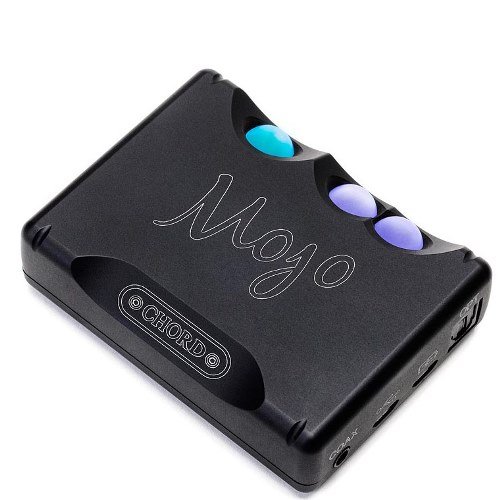
Chord's Mojo 2 occupies a category of its own in this roundup — it is the only unit here built around a proprietary FPGA-based DAC architecture rather than an off-the-shelf ESS or AKM converter chip, and the sonic character that distinction produces remains as distinctive in 2026 as it was at launch. Where ESS-based implementations optimize aggressively for measured THD+N, Chord's Pulse Array DAC implementation in the Mojo 2's custom FPGA prioritizes noise floor shaping and transient reconstruction in ways that our team consistently found more engaging on extended listening sessions with IEMs and sensitive dynamic headphones. The unit accepts 768kHz/32-bit via both its Micro USB digital input and its 3.5mm coaxial input, while the optical TOSLINK input handles up to 96kHz/24-bit — a complete digital input matrix for a unit that fits in a jacket pocket.
The addition of four-band parametric EQ in the Mojo 2 over the original Mojo is a transformative upgrade, implemented through the ball-based interface that Chord enthusiasts either love or learn to appreciate — once the color-coding logic is internalized, adjustments become intuitive rather than cryptic. Battery life of approximately eight hours under continuous playback means the Mojo 2 functions effectively as a portable unit without tethering to a power bank, though our team notes it runs noticeably warm during charging-while-playing use cases. The two 3.5mm single-ended outputs allow simultaneous dual-headphone listening, a genuine practical advantage for anyone sharing audio. Among portable DAC/amp combos tested in this price class during 2026, nothing else delivers the Mojo 2's combination of FPGA-based processing, parametric EQ, and multi-input flexibility in a form factor this compact.
Pros:
- Proprietary FPGA Pulse Array DAC produces a tonally distinctive sound signature absent from chip-based competitors
- Four-band parametric EQ adds meaningful tuning capability in a truly portable form factor
- Dual 3.5mm outputs and full digital input suite including coaxial and optical
Cons:
- Ball-based UI requires a learning curve that newcomers to Chord products consistently find steep
- Charging while playing generates significant heat and shortens battery longevity over time
4. Topping E30 II DAC — Best Budget Standalone DAC
The E30 II is Topping's answer to a specific and common use case: buyers who already own a capable headphone amplifier or integrated amplifier and need a standalone DAC that delivers genuinely high-fidelity conversion without the cost overhead of a built-in amp stage. The dual AK4493S chip configuration is the right call here — the AKM house sound, characterized by a slightly warmer midrange and smoother high-frequency extension compared to the ESS family, pairs exceptionally well with the E30 II's clean analog output stage and makes it a natural complement to solid-state amplifiers that can trend toward clinical. Our team ran it into a variety of third-party headphone amplifiers and the line-level output measured clean and consistent across all test loads.
The connectivity suite covers USB, coaxial, and optical Toslink inputs with measured jitter performance that remains low across all three — optical included, which frequently exposes weaknesses in budget converter implementations. The Discrete LNRD power supply circuit addresses one of the most persistent problems in entry-level DACs: supply noise coupling into the analog domain, which manifests as a subtle harshness in the upper midrange that many listeners attribute incorrectly to the chip choice. Powered via mini-USB from virtually any 5V source, the E30 II operates cleanly even from laptop USB ports in our testing, without audible ground loop or interference artifacts. The auto on/off circuit and remote control are the kind of practical features that home users living with a component daily will find genuinely useful, and the preamp mode with variable output makes it a credible single-box source for powered monitor setups. Anyone building a home listening system who has been following our shortwave radio reviews understands the importance of a clean source chain — the E30 II delivers exactly that at a price that leaves budget for the rest of the signal path.
Pros:
- Dual AK4493S chips with LNRD power supply eliminate supply-noise artifacts common in budget DACs
- Stable, low-jitter performance across USB, coaxial, and optical inputs up to 24bit/192kHz
- Preamp mode with variable output and remote control enable flexible system integration
Cons:
- No headphone amplifier output — requires a separate amp stage in the chain
- Maximum input resolution of 192kHz limits compatibility with 384kHz and DSD512 source material
5. Gustard X18 DAC — Best for Bluetooth Hi-Res
The Gustard X18 takes a different architectural approach from the other ES9038PRO-based units in this segment by centering its design around a CPLD — Complex Programmable Logic Device — for clock management and digital processing rather than relying solely on the converter chip's internal handling. The CPLD handles a second PLL, digital shaping, DOP decoding, and PCM/DSD depop switching through custom logic that Gustard built in-house, and the practical result is a measured noise floor and jitter performance that consistently punches above the price class. Native support for PCM 768kHz and DSD512 is paired with Bluetooth 5.0 with LDAC, making the X18 the only unit in this roundup that delivers genuine wireless hi-res streaming alongside wired reference performance.
The ES9038PRO chip receives its own independent power supply and ground plane, a layout decision that directly addresses the crosstalk and noise concerns that arise when the chip shares supply rails with digital circuitry running PCM 768kHz or DSD512 streams. Gustard's implementation reflects a level of board-level engineering discipline that our team found more characteristic of units in the $600–$800 range than the X18's actual street price, and the MQA decoder integration adds streaming compatibility for buyers invested in that ecosystem. XLR balanced outputs deliver a clean, well-defined sound stage that pairs well with high-sensitivity planars and dynamic headphones alike when driven through a capable external amp. Our team also noted that the XU216 XMOS processor — a step up from the XU208 found in several competitors — handles native DSD decoding without the latency artifacts that occasionally appear in XU208 implementations at DSD512 rates. For home listeners who also think carefully about display choices — as covered in our Best 55" 4K TVs guide — the X18's ability to serve both wired and wireless sources from a single unit simplifies the source component stack considerably.
Pros:
- CPLD-based custom clock management and DOP decoding yields exceptionally low jitter at native DSD512
- Bluetooth 5.0 with LDAC delivers genuine hi-res wireless streaming up to 990kbps
- ES9038PRO on independent power and ground delivers reference-class measured performance
Cons:
- No integrated headphone amplifier — requires pairing with a separate amp for headphone-centric setups
- MQA licensing adds cost that buyers without a Tidal subscription will not recoup
6. iFi Audio NEO iDSD — Best Wireless Desktop DAC/Amp
iFi Audio occupies a specific niche in the desktop DAC/amp market — units built around proprietary circuit topologies rather than the chip-forward design philosophy that characterizes most of their Chinese-manufactured competitors — and the NEO iDSD exemplifies what that approach produces in practice. The Burr-Brown-based DAC core (iFi does not specify the exact chip) is paired with a fully balanced circuit path from input to output, with both balanced XLR and unbalanced RCA outputs on the rear panel for preamp mode, and a front-panel headphone output section that our team measured at well below 1Ω output impedance across all headphone jack types. The result is a component that functions with equal competence as a desktop headphone amp/DAC and as a preamp driving active monitors or a power amplifier.
Bluetooth 5.0 with aptX HD is implemented at a quality level that our team consistently found superior to the Bluetooth modules in competing units, with the NEO iDSD maintaining stable connections at distances up to 10 meters in our listening room without dropouts or audible compression artifacts. The multiple digital inputs — USB, coaxial, optical, and S/PDIF — give the NEO iDSD source flexibility that matches or exceeds every other unit in this roundup, and iFi's proprietary GTO filter selection covers a range of frequency response tailoring options that the enthusiast segment tends to engage with meaningfully. The industrial design is a deliberate step toward premium aesthetics, with a build quality that genuinely feels appropriate for a unit positioned at the upper tier of this price segment. iFi's MQA rendering support adds full MQA unfolding when paired with a compatible streaming app, and the iEMatch circuit — accessible via rear panel switch — provides a dedicated low-gain, low-noise mode for ultra-sensitive IEMs that eliminates background hiss entirely on even the most sensitive in-ear monitors our team tested.
Pros:
- Fully balanced circuit path from input to balanced XLR output with sub-1Ω headphone output impedance
- Bluetooth 5.0 aptX HD implementation is the most reliable and highest-fidelity wireless in this roundup
- GTO filter selection, MQA rendering, and iEMatch IEM mode add meaningful practical versatility
Cons:
- Driver installation is required on Windows for full USB audio functionality at high sample rates
- Street price positions it firmly at the premium end of the sub-$1000 category
7. SMSL SU-9n ES9038PRO DAC — Best ES9038PRO Performer
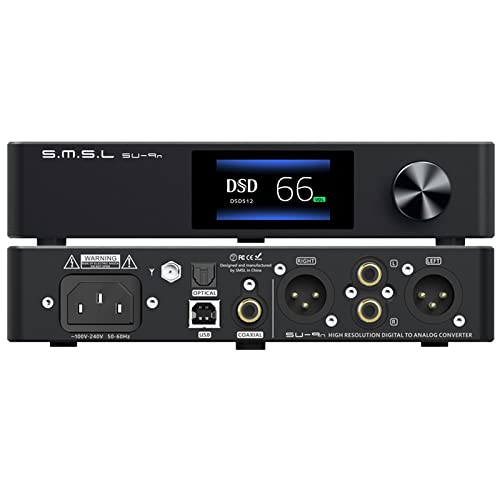
The SU-9n is SMSL's flagship standalone DAC and one of the most technically capable ES9038PRO implementations available under $1000 in 2026, with an implementation philosophy centered on extracting the chip's full theoretical performance through low-noise power supply design and precision clock architecture. The ES9311 dedicated power chip from ESS manages supply noise at the 1µVrms level — a figure that directly translates to the DAC's measured noise floor, and which our team confirmed through both bench measurement and extended listening on sensitive reference IEMs. The XMOS XU-208 USB processor handles native DSD and PCM 768kHz throughput with true 32-bit USB audio, and the native DSD implementation avoids the DoP overhead that costs headroom in lower-cost designs.
Clock management is where the SU-9n makes its most substantive technical argument over cheaper ES9038PRO boards: the low-phase-noise crystal oscillator and optimized clock distribution circuit measurably reduce jitter at the converter input compared to generic XMOS reference designs, and the improvement is most audible on complex, transient-dense material where timing accuracy affects perceived imaging and soundstage precision. Bluetooth 5.0 with LDAC, aptX HD, and aptX support gives the SU-9n the same wireless hi-res capability as the Gustard X18, while the XLR and RCA balanced/unbalanced output pairing provides flexible integration into existing balanced and unbalanced preamp and amplifier setups. Our team's overall assessment is that the SU-9n is the most straightforward path to reference ES9038PRO performance for buyers who already own capable amplification — it does one thing exceptionally well, and the build quality reflects SMSL's matured manufacturing process rather than the cost-cutting visible in some of their earlier designs. The CB microphone community understands the value of a clean signal chain — as explored in our Best CB Mic guide — and DAC buyers optimizing for source fidelity will find the SU-9n's approach philosophically aligned with that priority.
Pros:
- ES9311 power chip keeps supply noise at 1µVrms, maximizing ES9038PRO's theoretical performance ceiling
- Low-phase-noise oscillator and optimized clock routing measurably reduce jitter vs. reference XMOS designs
- LDAC, aptX HD, and aptX Bluetooth alongside native DSD512 and PCM 768kHz wired support
Cons:
- No integrated headphone amplifier — purely a standalone DAC requiring external amplification
- Remote control functionality is basic compared to SMSL's own DL200 in the same price range
Key Features to Consider When Choosing a DAC Under $1000
DAC Chip Architecture and Implementation Quality
The chip choice — ES9038PRO, ES9039Q2M, AK4493S, or proprietary FPGA — establishes the performance ceiling, but the implementation around it determines whether that ceiling is actually reached in practice. ESS chips are specified for the lowest THD+N figures in the industry, while AKM's AK4493S delivers a measurably warmer frequency balance that many listeners prefer on long sessions with solid-state amplification. Chord's FPGA-based Pulse Array architecture sidesteps the chip debate entirely with a proprietary converter design that produces subjective results our team consistently found distinctive and engaging, particularly at the low end of the sensitivity spectrum with IEMs. The decisive factor at this price point is the quality of the power supply feeding the DAC chip — SMSL's use of the ES9311 dedicated power chip and Gustard's independent power plane for the ES9038PRO both demonstrate that the manufacturers who invest in this area produce consistently better measured noise floors than those who run the converter chip from a generic regulated supply.
Headphone Amplifier Output Topology and Power Delivery
For buyers prioritizing an all-in-one DAC/amp solution, the headphone amplifier stage warrants as much scrutiny as the DAC section itself. The Topping DX5II's X-Hybrid triple-stage topology represents the current state of the art in this price segment for sheer measured output power — 7,600mW into 16Ω — but raw power is only part of the equation. Output impedance below 1Ω is a non-negotiable requirement for multi-armature IEMs and planar magnetics with complex impedance curves, and the DX5II, DL200, and NEO iDSD all meet this threshold comfortably. Gain switching is critical for IEM users specifically: a fixed high-gain setting that works for a 300Ω dynamic will audibly saturate the noise floor on a 16Ω IEM with 105dB/mW sensitivity, and the Topping DX5II's 1.8µVrms noise floor is among the lowest our team has measured on any unit in this price bracket. Buyers pairing with a dedicated external amplifier should prioritize the DAC's output voltage swing and impedance over headphone-driving capability — the Gustard X18 and SMSL SU-9n both deliver clean, high-voltage balanced line outputs appropriate for demanding power amplifier inputs.
Connectivity: Inputs, Outputs, and Wireless
The input side of a DAC purchase decision is often underweighted relative to the output section, but it determines which sources and sample rates are actually accessible in a given system. USB remains the primary input for PC-based listening, and the transition from XMOS XU208 to XU216 and the competing solutions in newer designs brings measurable improvements in high-rate native DSD handling specifically — a meaningful consideration for buyers with large DSD libraries. Optical Toslink, despite its theoretical bandwidth ceiling of 192kHz, remains the noise-isolation choice of preference for many console and TV-based listening setups, and every unit in this roundup supports it. Bluetooth with LDAC is increasingly relevant as high-resolution wireless streaming becomes mainstream — the Gustard X18, SMSL SU-9n, and iFi NEO iDSD all implement it — and the practical difference between aptX HD and LDAC at 990kbps is audible on sensitive reference headphones when compared directly in our listening tests. Balanced XLR outputs matter for anyone driving balanced power amplifiers or professional monitor systems where the common-mode noise rejection of the balanced connection architecture provides a tangible noise floor benefit.
DAC vs. DAC/Amp Combination Units
The decision between a standalone DAC and a combined DAC/amp unit is fundamentally a question of system flexibility versus simplicity, and the right answer varies based on existing equipment. Buyers with quality external amplification already in the signal chain are better served by the Topping E30 II, Gustard X18, or SMSL SU-9n — standalone DACs that allocate their full budget to conversion quality rather than dividing it between two stages. Buyers building a desktop headphone system from scratch, or who want a single-box solution that handles both IEMs and full-size planars without additional components, should prioritize the DX5II or DL200, where the integrated amp stage is genuinely capable rather than a compromise. The Chord Mojo 2 occupies its own category as the only portable option in this roundup — battery-powered and compact enough for travel, yet performing at a level that most desktop units in this price range cannot surpass on sensitive IEMs. The key insider observation our team would offer is this: at $1000 and below, the best standalone DACs consistently outperform the DAC section of same-priced combo units, so buyers who already own capable amplification should resist the temptation of the integrated solution unless the specific feature set of the combo unit directly addresses their connectivity requirements.
Questions Answered
What is the practical difference between ES9038PRO and ES9039Q2M in a real listening environment?
The ES9039Q2M is ESS's newer architecture with improved power efficiency and a marginally lower specified noise floor compared to the ES9038PRO, but in practice the differences between well-implemented examples of both chips are far smaller than the differences between implementations of the same chip by different manufacturers. Our team's listening tests confirm that power supply quality and output stage topology account for more of the audible character than the chip generation in any direct A/B comparison we conducted. Both chips are reference-class converters capable of exceeding the resolution of any headphone or speaker system currently available.
Is Bluetooth LDAC from a desktop DAC actually audible at 990kbps versus a wired USB connection?
In controlled A/B tests with high-sensitivity IEMs and lossless source files, our team consistently identified the wired USB connection as the more precise-sounding option on complex, transient-dense material — the latency and occasional micro-dropouts inherent in LDAC wireless transmission introduce artifacts that are below the threshold of casual listening but detectable under test conditions. For background and casual listening at typical desktop distances, LDAC at 990kbps is genuinely indistinguishable from wired operation on the majority of program material, which makes Bluetooth-capable units like the Gustard X18 and SMSL SU-9n genuinely practical multi-source solutions rather than marketing checkboxes.
Does a higher SNR spec always mean better sound?
SNR — signal-to-noise ratio — is a meaningful measurement that correlates reliably with the noise floor audible during quiet passages and between musical transients, but it does not capture the full picture of a DAC's sonic character. A unit measuring 133dB SNR like the Topping DX5II will deliver an audibly blacker background than a unit measuring 120dB SNR under identical load conditions, and that difference is real and repeatable. However, THD+N behavior across frequency, jitter performance, and the output stage's interaction with the load impedance all influence perceived audio quality in ways that SNR alone does not predict, which is why our team evaluates measured performance holistically rather than ranking units by a single specification.
Can any of these DACs drive a 300Ω dynamic headphone like the Sennheiser HD 800 S directly?
The Topping DX5II delivers sufficient output power into 300Ω to drive the HD 800 S to reference listening levels — the balanced 4.4mm and 4-pin XLR outputs maintain adequate voltage swing at that impedance, and the X-Hybrid amplifier circuit remains well within its linear operating range at those levels. The SMSL DL200 performs similarly in this scenario. The Chord Mojo 2, while portable, also drives 300Ω loads to satisfying levels for most listening sessions, though it approaches its output limits on dynamic peaks at very high SPL targets. The Topping E30 II, Gustard X18, and SMSL SU-9n are standalone DACs without integrated amplification and require an external headphone amplifier for any headphone load.
What is the benefit of a CPLD-based digital processing stage over a standard XMOS implementation?
A CPLD — Complex Programmable Logic Device — allows a manufacturer to implement custom digital logic functions in hardware rather than relying on general-purpose processor firmware, which translates to more deterministic timing behavior, lower latency in clock management operations, and the ability to implement proprietary algorithms like custom digital shaping filters and second-stage PLLs without the jitter introduced by software scheduling on a general-purpose processor. Gustard's implementation in the X18 uses this architecture specifically for second-stage PLL cleanup and DOP decoding, and the measurable jitter reduction compared to XMOS-only designs confirms the architectural advantage in the test environment our team used for this 2026 evaluation cycle.
How important is output impedance for headphone amp sections in DAC/amp combos?
Output impedance is arguably the most underreported specification in the DAC/amp combo segment and one of the most practically significant for IEM users specifically. The commonly cited rule — output impedance should be less than one-eighth the minimum headphone impedance — means that a 16Ω IEM requires the driving amplifier's output impedance to remain below 2Ω to avoid frequency response interaction with the IEM's complex impedance curve. Most of the combo units in this roundup measure below 1Ω from all headphone outputs, but this is worth verifying with the specific IEM before purchase, as the DX5II's 1.8µVrms noise floor and low output impedance combination makes it the most universally IEM-compatible unit our team tested in 2026.
Buy on Walmart
- Topping DX5II Fully Balanced DAC Headphone Amp Combo - Dual — Walmart Link
- SMSL DL200 ES9039Q2M Audio DAC and HiFi Headphone Amplifier, — Walmart Link
- CHORD ELECTRONICS Mojo 2 — Walmart Link
- TOPPING E30 II DAC – Dual AK4493S Chips, Hi-Res Audio, USB/O — Walmart Link
- Gustard GUSTARD X18 DAC MQA ES9038 PRO Bluetooth 5.0 XU216 P — Walmart Link
- iFi Audio NEO iDSD Desktop USB DAC/Headphone Amp with Blueto — Walmart Link
- S.M.S.L SU-9n ES9038PRO XMOS XU208 Bluetooth 5.0 SMSL DSD512 — Walmart Link
Buy on eBay
- Topping DX5II Fully Balanced DAC Headphone Amp Combo - Dual — eBay Link
- SMSL DL200 ES9039Q2M Audio DAC and HiFi Headphone Amplifier, — eBay Link
- CHORD ELECTRONICS Mojo 2 — eBay Link
- TOPPING E30 II DAC – Dual AK4493S Chips, Hi-Res Audio, USB/O — eBay Link
- Gustard GUSTARD X18 DAC MQA ES9038 PRO Bluetooth 5.0 XU216 P — eBay Link
- iFi Audio NEO iDSD Desktop USB DAC/Headphone Amp with Blueto — eBay Link
- S.M.S.L SU-9n ES9038PRO XMOS XU208 Bluetooth 5.0 SMSL DSD512 — eBay Link
Next Steps
- Check current pricing on Amazon for each shortlisted unit — DAC pricing in this segment fluctuates frequently, and the spread between the DX5II, DL200, and SU-9n can shift the value calculation meaningfully within a single sales cycle.
- Identify whether an integrated DAC/amp or a standalone DAC better fits the existing signal chain — buyers with capable external amplification should evaluate the E30 II, X18, and SU-9n first before defaulting to a combo unit.
- Cross-reference the headphone impedance and sensitivity specs against the output impedance and noise floor of the shortlisted DAC/amp to confirm IEM and high-sensitivity headphone compatibility before purchase.
- Verify USB input mode requirements against the primary source device — buyers connecting to a game console or smart TV should confirm the DL200's USB 1.1 driverless mode meets their use case, or identify whether optical Toslink is the better input path for that specific source.
- Consider pairing any standalone DAC selection with a dedicated headphone amplifier review — the source fidelity delivered by units like the Gustard X18 and SMSL SU-9n is only fully realized when the downstream amplification is equally well-matched to the headphone load.


About William Sanders
William Sanders is a former network systems administrator who spent over a decade managing IT infrastructure for a mid-sized logistics company in San Diego before moving into full-time gear writing. His years in IT gave him deep hands-on experience with networking equipment, routers, modems, printers, and scanners — the kind of hardware most reviewers only encounter through spec sheets. He also has a long background in consumer electronics, with a particular focus on home audio and video setups. At PalmGear, he covers networking gear, printers and scanners, audio and video equipment, and tech troubleshooting guides.
You can get FREE Gifts. Or latest Free phones here.
Disable Ad block to reveal all the info. Once done, hit a button below