RV Gear ›
What Size Inverter Do I Need For My RV?
by Jake Mercer
Determining what size inverter is needed for an RV comes down to a single calculation: total the running wattage of every AC device intended to operate simultaneously, then multiply by 1.2 for safety headroom. That figure defines the minimum continuous output rating required. Our team has evaluated inverters across every RV class — from compact Class B van conversions to 45-foot Class A diesel pushers — and the fundamental sizing methodology never changes, only the numbers do. For a complete overview of power components and mobile accessories, our RV gear section covers the full ecosystem of equipment we evaluate.

A power inverter converts 12V or 24V DC battery power into 120V AC power, replicating shore power for sensitive electronics aboard the vehicle. Without proper sizing, the consequences range from nuisance circuit tripping to permanent damage to both the inverter and connected appliances. The inverter is not merely a convenience component — it is the central nervous system of any off-grid or boondocking power configuration.
Most people underestimate the aggregate wattage of an RV's simultaneous electrical load. A laptop charger, a small coffee maker, a CPAP machine, and an LED television can collectively demand 1,500 watts or more at peak draw, before accounting for motor startup surges. Getting this number right at the outset prevents considerable expense and frustration during remote travel.
Contents
- The Physics of DC-to-AC Conversion in Mobile Environments
- Sizing Your RV Inverter: Load Calculation Methodology
- Inverter Classes and What Each Price Tier Delivers
- Sizing Errors That Cripple RV Power Systems
- Building a Scalable RV Power Architecture for the Long Term
- Maintaining Your RV Inverter for Sustained Performance
- Frequently Asked Questions
The Physics of DC-to-AC Conversion in Mobile Environments
Understanding what size inverter is needed for an RV begins with understanding how inverters actually convert power. DC-to-AC inversion involves high-frequency switching transistors that chop the DC input, then filter and reshape the result into a sinusoidal waveform. Two fundamental waveform types define the market: modified sine wave and pure sine wave, and the distinction carries significant practical consequences.
Modified Sine Wave vs. Pure Sine Wave
Modified sine wave inverters approximate a sine wave using a stepped waveform. They are adequate for resistive loads such as incandescent lighting, simple heating elements, and basic battery chargers. However, they introduce harmonic distortion that causes audible buzzing in audio equipment, overheating in AC motors, and erratic behavior in variable-speed tools and medical devices such as CPAP machines.
Pure sine wave inverters replicate utility-grade AC power with less than 3% total harmonic distortion. Sensitive electronics — including modern laptop power adapters, inverter air conditioners, and precision audio gear — demand this level of power quality. Our team recommends pure sine wave as the default specification for any full-time or extended-use RV installation. The incremental cost over modified sine wave units is fully justified by compatibility and long-term reliability alone.
Sizing Your RV Inverter: Load Calculation Methodology
The load calculation is the central exercise in answering the question of what size inverter is needed for an RV. It requires cataloging every AC device by both running wattage and startup surge wattage — two figures that diverge substantially for motor-driven appliances.
Running Wattage vs. Surge Wattage
Running wattage is the steady-state consumption after a device has stabilized. Surge wattage — also called startup or peak wattage — is the brief spike that occurs when motors and compressors initiate. A 700W microwave may draw 1,400W for the first 200 milliseconds. A 13,500 BTU rooftop air conditioner runs at roughly 1,500W but surges to 3,000W or more at startup. The inverter's surge rating must accommodate these peaks without tripping the protection circuitry.
Common RV Appliance Wattage Reference
| Appliance | Running Watts | Surge Watts | Notes |
|---|---|---|---|
| CPAP (no heated humidifier) | 30–60 | 60–120 | Pure sine wave required |
| Laptop (65W adapter) | 45–65 | 65–80 | Pure sine wave preferred |
| LED Television (40") | 40–80 | 80–150 | Modified sine wave tolerates |
| Coffee Maker | 800–1,200 | 1,200–1,500 | High draw, short duration |
| Microwave (700W rated) | 700–1,100 | 1,000–1,400 | Most demanding common appliance |
| Rooftop AC (13,500 BTU) | 1,200–1,500 | 2,500–3,500 | Soft-start module strongly recommended |
| Hair Dryer | 1,500–1,875 | 1,875–2,000 | Resistive load; modified sine acceptable |
| Electric Blanket | 150–200 | 200–250 | Simple resistive load |
Our team's recommended procedure: list every device likely to operate simultaneously during peak usage — not average usage — and sum their running watts. Multiply that figure by 1.2 to establish the continuous output rating, then confirm the inverter's surge rating covers the highest single-device startup spike. For most Class C and Class A rigs running a microwave, entertainment system, and CPAP concurrently, a 2,000W pure sine inverter is the practical minimum. Full-time setups incorporating air conditioning demand 3,000W continuous or higher.
Inverter Classes and What Each Price Tier Delivers
Budget allocation for an RV inverter is not purely a cost decision — it is a reliability decision with real consequences during remote travel where no dealer service is nearby. Our team segments the market into three tiers based on build quality, feature set, and warranty terms.
Entry-Level: $80–$300
Entry-level inverters in the 300W–1,500W range typically operate as modified sine wave units with efficiency ratings between 85–88%. Warranty terms rarely exceed twelve months. Thermal management in this tier relies on undersized fans and minimal heatsink mass, creating noise and shortened service life under sustained loads. These units serve occasional, low-draw applications adequately — nothing more.
Mid-Range: $300–$800
The mid-range segment covers 1,500W–3,000W in pure sine wave configurations, with efficiency improving to 90–93%. Most units at this tier include remote on/off switches, USB charging ports, and comprehensive multi-stage protection circuitry covering under-voltage, over-voltage, overload, short circuit, and thermal shutdown conditions. This is the tier where most full-time RV travelers should direct their investment.
Premium: $800–$3,000+
Premium inverter/charger units from Victron Energy, Magnum, and Xantrex combine inverter and charger functions in a single chassis, communicate with battery management systems over CAN bus or RS485, and carry three-to-five year warranties. These units are engineered for mission-critical installations where reliability over years of continuous use justifies the capital outlay. For those simultaneously evaluating the audio infrastructure of their rig, our 12-inch subwoofer guide addresses how high-current audio systems interact with inverter load budgets and battery draw calculations.
Sizing Errors That Cripple RV Power Systems
The most persistent error our team observes is sizing relative to maximum single-device load rather than realistic simultaneous load. Most people calculate the wattage of their largest appliance and select that figure as their inverter rating. This ignores the reality that a microwave, refrigerator compressor, and entertainment system frequently run at the same time.
Never size an inverter to its maximum rated output — sustained operation above 80% of continuous rating accelerates thermal wear and reduces service life by years.
Ignoring Surge Ratings
Undersizing the surge rating is equally damaging. Selecting a 2,000W inverter with a 4,000W surge rating for a system that requires 6,000W at air conditioner startup guarantees nuisance shutdowns at the worst possible moments. Soft-start modules — add-on components that reduce AC compressor startup current by 60–70% — solve this problem elegantly when installed directly at the air conditioning unit. Our team considers soft-start adapters essential for any inverter-powered rooftop AC system.
Neglecting DC Cable Sizing
The DC cabling between the battery bank and the inverter is frequently under-specified. A 2,000W inverter drawing from a 12V system pulls approximately 167 amperes under full load. Undersized cables create resistive losses that manifest as heat, voltage drop, and reduced effective inverter capacity — the electrical equivalent of a kinked garden hose. Our team recommends consulting ABYC or NEC wiring tables and specifying one cable gauge larger than the calculated minimum for any run exceeding three feet.
Building a Scalable RV Power Architecture for the Long Term
An inverter purchased precisely for current needs and incapable of accommodating future expansion represents poor long-term engineering. Our team advocates sizing 25–30% above the current calculated load, providing headroom for appliances added in subsequent seasons without requiring a complete system replacement.
Battery Bank Integration
The inverter is only as capable as the battery bank sustaining it. Lithium iron phosphate (LiFePO4) chemistry has fundamentally changed mobile power strategy, delivering 95–98% usable depth of discharge versus approximately 50% for lead-acid, at three to four times the cycle life. A 2,000W inverter at full load draws down a 200Ah LiFePO4 bank at roughly 167 amperes — a rate that well-matched lithium systems handle without the voltage sag that plagues lead-acid configurations under identical demand.
A properly matched LiFePO4 battery bank paired with a pure sine inverter will outlast the vehicle it powers — this combination is the backbone of any serious long-term boondocking infrastructure.
Solar and Charging Integration
Pairing an inverter with a rooftop solar array and MPPT charge controller creates a closed-loop energy system that dramatically reduces generator dependence. Premium inverter/charger units from Victron and Magnum integrate directly with MPPT controllers, providing a unified view of energy production, storage, and consumption via mobile app. For those also managing connectivity infrastructure aboard the rig, our mesh Wi-Fi setup guide covers how to maintain reliable network access during boondocking — a consideration that adds modest but real wattage to the system power budget.
Maintaining Your RV Inverter for Sustained Performance
An inverter requires less maintenance than most mechanical systems on a vehicle, but neglect accumulates into preventable failures. Our team's maintenance protocol centers on three pillars: thermal management, connection integrity, and firmware currency.
Thermal Management
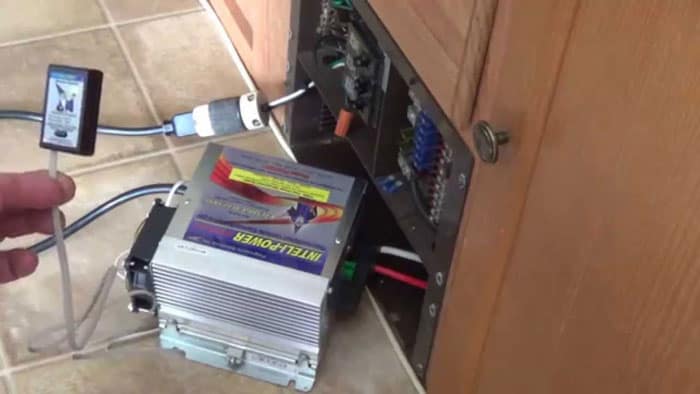
Inverters generate heat proportional to load and conversion losses. Installation in a well-ventilated compartment with at least six inches of clearance on all sides is the minimum standard. Internal cooling fans that activate at defined temperature thresholds accumulate dust over time, reducing airflow and elevating internal operating temperatures. Compressed air cleaning every six months is sufficient for typical RV environments; dusty desert or off-road travel warrants quarterly attention.
Connection Integrity and Terminal Inspection
DC terminal connections at both the inverter and battery bank are subject to vibration, thermal cycling, and galvanic corrosion — three forces that conspire to loosen what was once a tight joint. Our team recommends torquing connections to manufacturer specifications at installation and re-inspecting annually. Loose connections generate resistance, heat, and arcing, degrading both the inverter and the cable lugs. Dielectric grease applied to all battery terminals reduces corrosion buildup substantially. For those managing exterior electrical connection points in corrosive environments, our automotive clear coat guide addresses corrosion-resistant finishing strategies with direct applicability to exposed hardware.
Firmware Updates and Performance Monitoring
Premium inverters from Victron and Magnum release periodic firmware updates addressing protection algorithm refinements and communication protocol improvements. Monitoring inverter performance via manufacturer app or a dedicated battery monitor provides early warning of efficiency degradation — a reliable signal that battery capacity is declining and replacement planning should begin. Tracking consumption trends over months informs both maintenance schedules and equipment replacement timing with objective data rather than guesswork.
Frequently Asked Questions
What size inverter is needed for most RV setups?
For a typical RV running a microwave, entertainment system, CPAP machine, and phone chargers simultaneously, a 2,000W pure sine wave inverter represents the practical minimum. Full-time setups with rooftop air conditioning require 3,000W continuous output or greater, with a surge rating above 6,000W unless a soft-start module is installed at the AC unit.
Can a 1,000W inverter run a microwave in an RV?
A 1,000W inverter can operate a 700W-rated microwave, but with minimal safety margin — a single simultaneous draw from another device risks overload shutdown. Our team recommends a minimum 1,500W continuous rating for any installation where a microwave is the primary load, and 2,000W when other devices may operate concurrently.
Is a pure sine wave inverter necessary for a CPAP machine?
Pure sine wave output is essential for CPAP machines. Modified sine wave inverters introduce harmonic distortion that causes motor noise, overheating of internal components, and erratic pressure regulation in devices with variable-speed motors. Most CPAP manufacturers explicitly void the warranty when modified sine wave power sources are used.
What is the difference between a 12V and 24V inverter system?
A 24V system operates at half the current of a 12V system for identical wattage output, which allows smaller-gauge DC cables and reduces resistive losses across long cable runs. Most factory RV electrical systems are 12V; 24V installations are common in high-capacity custom builds where efficiency over long cable runs justifies the additional battery configuration complexity.
How long will a battery bank power a 2,000W inverter?
At full 2,000W load from a 12V system, current draw reaches approximately 167 amperes. A 200Ah LiFePO4 bank provides roughly 1.2 hours at that load before reaching the recommended minimum state of charge. At 50% load — a more realistic scenario — runtime extends to approximately 2.4 hours. Real-world runtime depends on actual simultaneous load, not theoretical maximum.
Can an RV inverter run the rooftop air conditioner?
A rooftop air conditioner can operate from an inverter when two conditions are met: the inverter's continuous rating exceeds the AC unit's running wattage by at least 20%, and either the inverter's surge rating accommodates the startup spike or a soft-start module is installed. A 3,000W pure sine inverter paired with a soft-start adapter handles a 13,500 BTU unit reliably in our team's testing.
Where should an RV inverter be installed?
The inverter should be mounted as close to the battery bank as safely possible — ideally within three feet — to minimize DC cable length and associated resistive losses. The compartment must provide adequate ventilation, maintain ambient temperatures below the inverter's maximum specification, and remain accessible for annual connection inspection. Inverters must never be installed in sealed, unventilated spaces due to heat accumulation risk.
The right inverter size is not the one that handles today's load — it is the one that handles everything that will ever be plugged in, at the same time, on the coldest night of the year, far from any shore power hookup.


About Jake Mercer
Jake Mercer spent twelve years behind the wheel as a long-haul trucker, covering routes across the continental United States and logging well over a million miles. That career gave him an unusually thorough education in CB radio equipment — he has tested base station antennas, magnetic mounts, coax cables, and handheld units in real-world conditions where reliable communication actually matters. After leaving trucking, Jake transitioned to full-time RV travel and has since put hundreds of RV accessories through their paces across national parks, boondocking sites, and full-hookup campgrounds from Montana to Florida. At PalmGear, he covers RV gear and accessories, CB radios, shortwave receivers, and handheld radio equipment.
You can get FREE Gifts. Or latest Free phones here.
Disable Ad block to reveal all the info. Once done, hit a button below