How to Hem Jeans with or without a Sewing Machine
by Alice Davis
Our team picked up a great pair of jeans at a thrift store last spring — perfect wash, right fit everywhere except the length. They dragged on the floor by a solid three inches. The local tailor wanted $25 and a two-day turnaround. We went home and finished the job in under an hour. Learning how to hem jeans pants with and without sewing machine is one of those practical skills that pays off every single time denim runs too long. Whether there's a machine on the desk or just a hot iron available, both methods produce clean, lasting results when done correctly. Our full sewing and crafts guide collection covers everything from basic alterations to vinyl fabric projects — and hemming jeans is where most people find their footing.

Contents
Why Getting the Right Inseam Length Changes Everything
Denim is one of the most durable fabrics ever developed. According to Wikipedia, denim originated as a heavy cotton twill built for hard workwear — designed to outlast nearly everything. That durability is exactly why a bad hem is such a waste. A sloppy or unsecured hem on denim unravels fast, drags on pavement, and ruins a pair of jeans long before the fabric itself gives out.
Most jeans come in standard inseam lengths — typically 30, 32, or 34 inches. Those numbers don't fit everyone. Petite frames, shorter legs, and proportions that fall between standard sizes all run into the same problem: too-long denim.
Here's what happens when the problem gets ignored:
- The raw hem drags on pavement and wears through at the back edge within weeks
- Excess fabric bunches at the ankle and looks untidy throughout the day
- Folding and cuffing works temporarily but shifts and unrolls constantly
- The jeans look worn-out long before the denim actually wears out
Hemming solves all of this permanently. Our team has hemmed dozens of pairs using both machine and no-machine methods, and the results are indistinguishable from store-bought finishing when the right technique gets applied. The key is knowing which method fits the situation.
The Complete Toolkit for Hemming Jeans at Home
Tools for the No-Machine Method
The no-machine approach works for anyone who doesn't own a sewing machine, needs a same-day fix, or is trying hemming for the first time. These are the items our team keeps stocked for this method:
- Fabric scissors — sharp enough to cut cleanly through doubled denim without fraying or jagging the edge
- Iron-on hem tape (also called fusible web tape) — the backbone of no-sew hemming; available at any fabric or craft store
- Clothes iron — a standard household iron works; steam setting is recommended
- Seam ripper — removes the original factory hem cleanly without damaging surrounding fabric
- Measuring tape or rigid ruler
- Tailor's chalk or fabric marker — marks the cut line without permanent staining
- Straight pins — hold the fold in position before ironing
- Pressing cloth — protects dark denim from iron scorch marks and heat discoloration
Anyone already comfortable with applying heat transfer vinyl with an iron will recognize immediately that precise heat control matters here just as much — too cool and the tape won't bond; too hot and the denim dye reacts badly.
Tools for the Sewing Machine Method
The machine method produces a more durable, professional result. Here's the full kit our team uses:
- Sewing machine — any standard home machine works; the needle and thread matter far more than the machine brand
- Denim needle (size 90/14 or 100/16) — non-negotiable; standard needles skip stitches or snap at thick seam intersections
- Heavy-duty thread — polyester or cotton-wrapped polyester in a color that matches the existing topstitching
- Seam ripper, fabric scissors, measuring tape, tailor's chalk (same as above)
- Iron and pressing cloth
- Wonder clips or straight pins — clips are easier to remove as the presser foot approaches on thick denim
A clean machine makes a real difference on dense fabric. Our guide on how to clean a sewing machine covers the full process — lint buildup in the bobbin area is the single most common reason machines skip stitches when sewing through multiple layers of denim.
How to Hem Jeans Pants Without a Sewing Machine
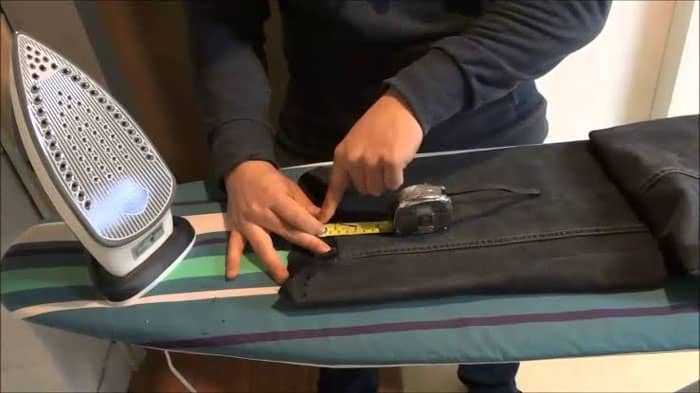
The no-machine method is our go-to recommendation for quick fixes and first-time hemming projects. Iron-on tape is not a flimsy shortcut — quality fusible tape bonded at the right temperature holds through dozens of washes without lifting.
Method 1: Iron-On Hem Tape
- Try on the jeans wearing the shoes most commonly worn with them. Footwear height shifts the ideal hem length by half an inch or more — skipping this step is one of the most common measurement errors.
- Mark the desired hem line with tailor's chalk while wearing the jeans. Our team marks at the ankle bone or just above — just above gives a cleaner visual break.
- Remove the jeans and add 1.5 inches below the chalk mark. This is the seam allowance: 0.5 inches folds under, 1 inch forms the visible hem face.
- Cut along the lower line with sharp fabric scissors. Cut slowly and deliberately — a jagged cut shows through the finished fold.
- Use the seam ripper to remove the original factory hem if it's still intact below the cut.
- Fold the raw cut edge under by 0.5 inches and press with the iron to crease it flat.
- Fold again up to the chalk mark and press firmly to create a crisp double fold.
- Tuck the hem tape inside the fold, sandwiched between the two denim layers all the way around the leg.
- Cover with a pressing cloth and press firmly with a hot iron — 10 to 15 seconds per 3-inch segment. Work in sections all the way around.
- Let the hem cool completely before handling. The bond forms during cooling, not while the iron is applied.
Pro insight: Our team always tests iron-on tape on a denim scrap first — different brands bond at slightly different temperatures, and some dark denim dyes react poorly to high heat directly, even through a pressing cloth.
Method 2: Hand Stitching
Hand stitching takes longer than tape but produces a more traditional-looking finish. The blind hem stitch (also called an invisible stitch) is the correct technique for denim:
- Use a sharp hand-sewing needle and heavy-duty thread in a matching or tonal color
- Catch only one or two threads of the outer denim layer per stitch — this keeps the stitching invisible from the front of the jeans
- Space stitches evenly at roughly 0.25 inches apart
- Knot firmly at both start and end — denim puts real stress on thread ends and loose knots unravel fast
- Pull the thread snug but not tight enough to dimple the outer fabric
Hand stitching pairs well with other needle-and-fabric techniques. Anyone interested in more detailed stitchwork should read our guide on how to applique with an embroidery machine — the principles of thread placement and fabric tension carry over directly.
How to Hem Jeans Pants With a Sewing Machine
Machine hemming is the permanent, long-term solution. It handles repeated washing, heavy wear, and physical stress better than tape or hand stitching over the long run. This is where knowing how to hem jeans pants with and without sewing machine really pays off — the machine method requires more setup but delivers results that hold for years without touching them again.
Step-by-Step Machine Hemming
- Remove the original factory hem using a seam ripper. Work slowly around the perimeter — rushing here tears the denim fibers around the stitching holes.
- Mark the new hem line with shoes on, using the same method described above.
- Add 0.75 to 1 inch seam allowance below the mark and cut. Machine hemming uses a shallower fold, so less allowance is needed compared to the no-sew method.
- Fold the raw edge under by 0.25 inches and press flat with the iron.
- Fold again up to the hem line and press to hold the crease.
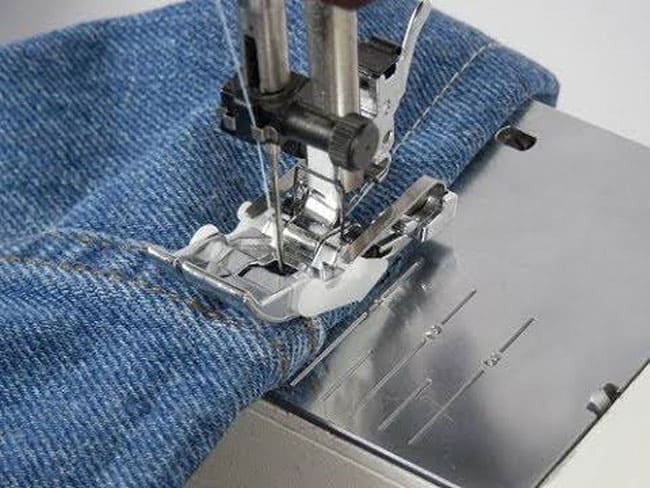
- Clip or pin the fold all the way around. Our team prefers wonder clips over pins on thick denim — they don't create tiny holes and are faster to remove as the presser foot approaches.
- Install a denim needle — size 100/16 for heavy raw denim, 90/14 for lighter-weight jeans denim.
- Thread the machine with heavy-duty polyester thread. Polyester has a slight stretch that moves with denim under stress, reducing thread breakage over time.
- Set the stitch length to 3.0–3.5mm. Shorter stitches are harder to remove if adjustments are needed and can over-perforate thick denim.
- Sew slowly around the leg, removing clips just before the presser foot reaches each one. Reduce speed by at least half when crossing the side seams — this is where four layers of denim stack up and machines strain.
- Backstitch firmly at the start and end to lock the hem in place.
- Press the finished hem with a hot iron to flatten and fully set the stitching into the fabric.
Mistakes That Ruin a Good Machine Hem
- Using a standard needle — it skips stitches or breaks outright at thick seam intersections; this is not negotiable
- Sewing full speed over side seams — slow down dramatically at these points; forcing the machine causes needle deflection and crooked stitching
- Skipping the final pressing step — an unpressed machine hem looks obviously homemade; the iron is what gives it a finished, tailored appearance
- Cutting the seam allowance too short — once denim is cut, there's no undoing it; measure twice and cut conservatively the first time
- Mismatched thread color — a noticeably wrong thread shade is visible from across the room; match the original topstitching color as closely as possible
Denim Hemming Myths That Hold People Back
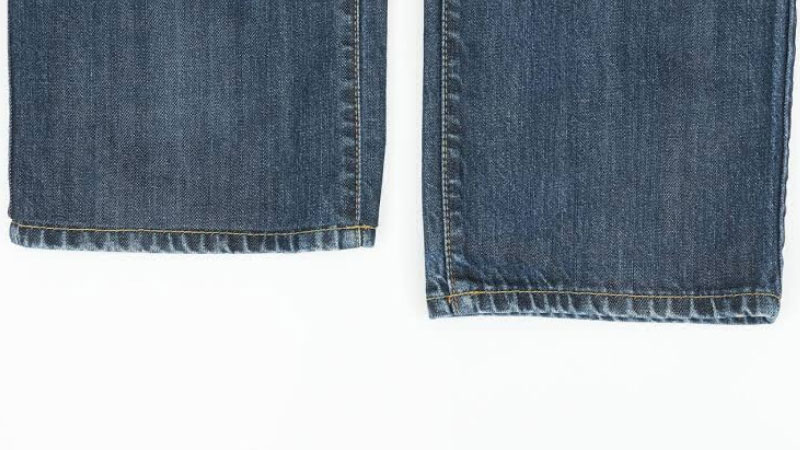
Our team hears the same hesitations from people who've never hemmed jeans before. Most of them are completely unfounded — here's the real picture:
- Myth: Hemming ruins the original look of the jeans.
False. A properly sewn or pressed hem is invisible from the outside. The only change visible is the length itself. - Myth: Only a professional tailor can hem denim without ruining it.
False. Anyone with a hot iron and $6 in hem tape can produce a clean, lasting result on the very first attempt. - Myth: Iron-on tape washes out after a few cycles.
False — when applied correctly. Cheap tape applied at too-low heat does wash out. Quality fusible tape bonded at the right temperature and cooled fully survives 50 or more wash cycles without lifting. - Myth: Home sewing machines can't handle thick denim.
Partially true — standard needles and regular thread genuinely can't. A denim needle with heavy-duty thread handles it without issue on any decent home machine. The machine is not the bottleneck; the supplies are. - Myth: The original factory hem can never be replicated at home.
True, but irrelevant. Factory hems use industrial chain stitching. Home machines create a lockstitch that is actually stronger under stress. The visual difference is minimal; the durability is equivalent or better.
Our experience with heat-based fabric applications backs this up entirely. Anyone who has worked through our guide on how to heat press a hat already understands that precise heat application produces professional-grade results without professional equipment — hemming denim follows exactly the same principle.
What It Actually Costs to Hem Jeans: DIY vs. Professional
Cost is one of the most compelling reasons to hem at home. Here's how the numbers compare based on our team's direct experience across both methods and professional alternatives:
| Method | Upfront Cost | Per-Pair Cost | Durability | Time Required |
|---|---|---|---|---|
| Professional tailor | $0 | $15–$30 | Excellent | Drop-off + pickup (1–3 days) |
| Iron-on hem tape (no machine) | $5–$10 | $0.50–$1.00 | Good (50+ washes with quality tape) | 30–45 minutes |
| Hand stitching | $3–$5 (needle + thread) | Near zero | Good (varies with stitch consistency) | 45–90 minutes |
| Sewing machine | $80–$300 (machine purchase) | Near zero | Excellent (years of hard use) | 20–40 minutes per pair |
The math is straightforward. Anyone hemming more than two pairs per year recoups the cost of hem tape in the first season. Anyone with a sewing machine already pays near-zero per pair after the initial equipment investment — and that machine earns its keep across a wide range of projects, not just denim. Our team runs ours constantly, from fabric crafts to equipment like our setup for connecting a vinyl cutter to a computer for custom cut projects.
Professional tailoring is the right call in three specific situations: expensive jeans over $150 where a mistake is costly, specialty washes where the hem finish is part of the garment's aesthetic, or raw selvedge denim where preserving the original chain stitch is important to the owner. For every other situation, DIY wins on cost, speed, and convenience.
Frequently Asked Questions
How long does iron-on hem tape last on jeans?
Quality fusible hem tape, applied at the correct temperature with a pressing cloth and allowed to cool fully, typically holds through 50 or more wash cycles. The bond fails prematurely when the iron isn't hot enough during application or when a low-grade tape brand gets used. Washing hemmed jeans inside-out on a gentle cycle extends the bond life significantly.
Can any home sewing machine hem thick denim?
Most standard home machines can handle denim hemming with the right consumables. The critical changes are a denim-specific needle (size 90/14 or 100/16) and heavy-duty polyester thread. Without those two upgrades, skipped stitches and broken needles at thick seam intersections are nearly guaranteed regardless of machine quality.
How much seam allowance should be left when hemming jeans?
For iron-on tape or hand stitching, our team leaves 1.5 inches below the chalk mark — 0.5 inches folds under and 1 inch forms the visible hem face. For machine hemming, 0.75 to 1 inch is sufficient. Too much allowance creates a bulky, stiff cuff that's uncomfortable and looks visibly thick from the outside.
Is it possible to hem jeans while keeping the original factory hem intact?
Yes — this is called the original hem technique. The jeans get folded up by the desired shortening amount, sewn just above the original hem, and the excess fold trimmed away. This preserves the factory chain stitching and any worn distressing on the original cuff. It works best when shortening by 1.5 inches or less, since larger folds create visible bulk at the ankle.
What thread color works best for hemming blue jeans?
For most standard blue denim, our team uses a dark gold or amber thread for the visible topstitch line — this closely matches the orange topstitching found on the vast majority of jeans. For the bobbin thread, which sits on the inside of the hem and stays hidden during wear, a plain white or natural grey thread works perfectly and saves the cost of a second specialty thread spool.
Final Thoughts
Mastering how to hem jeans pants with and without sewing machine is a skill that genuinely saves money, time, and a good pair of denim from the donate pile. Our team's clear recommendation: start with iron-on tape on an inexpensive pair to build confidence with the fold-and-press process, then move to machine hemming once the technique feels natural. Browse our full sewing and crafts section for guides that build directly on these skills — from heat transfer vinyl to embroidery machine work, every technique there reinforces the same hands-on fundamentals covered here.


About Alice Davis
Alice Davis is a crafts educator and DIY enthusiast based in Long Beach, California. She spent six years teaching textile design and applied arts at a community college, where she introduced students to everything from basic sewing techniques to vinyl cutting machines and heat press printing as practical, production-ready tools. That classroom experience means she has put more sewing machines, embroidery setups, Cricut systems, and heat press units through real project work than most reviewers ever will. At PalmGear, she covers sewing machines and embroidery tools, vinyl cutters, heat press gear, Cricut accessories, and T-shirt printing guides.
You can get FREE Gifts. Or latest Free phones here.
Disable Ad block to reveal all the info. Once done, hit a button below