RV Gear ›
10 Best RV Propane Regulators – Reviews and Guide 2026
by Jake Mercer
Over 8.5 million households in the United States own at least one RV, and every single one running propane appliances depends on a regulator that most owners never think about — until it fails mid-trip. A faulty or undersized RV propane regulator can cause everything from weak stove flames to dangerous pressure surges, making it one of the most safety-critical components in any RV's LP gas system. Our team has spent weeks evaluating the top models on the market in 2026, testing pressure consistency, build materials, and real-world installation across multiple rig configurations.

Whether the rig runs a single 20 lb cylinder or dual DOT tanks, picking the right regulator means matching BTU capacity, stage count, and connection type to the specific propane system. Two-stage regulators dominate the RV space for good reason — they reduce tank pressure in two steps rather than one, delivering more consistent 11" WC output pressure regardless of ambient temperature swings or tank fill level. Single-stage units still have their place for simpler setups, but most modern RVs with furnaces, water heaters, and cooktops benefit from the smoother delivery a dual-stage provides. For anyone upgrading other parts of their RV gear setup, the propane regulator should be near the top of the list.
We also looked at auto-changeover models — regulators that monitor two tanks simultaneously and switch from the primary to the reserve when one runs dry. These are essential for extended boondocking trips where running out of propane at 2 AM means a cold night. In this roundup, we cover everything from budget-friendly single-stage units to premium auto-changeover regulators with indicator flags. Every recommendation below is based on hands-on evaluation and cross-referenced against NFPA 58 compliance standards for LP gas installations.
Contents
Best Choices for 2026
- #PreviewProductRating
- Bestseller No. 1
 Rating:

- Bestseller No. 2
 Rating:
 - Bestseller No. 3
 Rating:
 - Bestseller No. 4
 Rating:
 - Bestseller No. 5
 Rating:
 - Bestseller No. 6
 Rating:
 - Bestseller No. 7
 Rating:
Detailed Product Reviews
1. AP Products Marshall Excelsior MEGR-253P — Best Two-Stage Vertical Mount
Marshall Excelsior has been a go-to name in LP gas regulation for decades, and the MEGR-253P continues that reputation. This is a two-stage vertical-mount regulator designed for RVs running a single propane tank. The first stage knocks inlet pressure down from up to 250 PSI, while the second stage delivers a steady 11" WC to the appliance manifold. Build quality is solid — the die-cast zinc body resists corrosion well, and the 1/4" female inverted flare inlet is the standard connection found on most RV pigtails.
During our testing, the MEGR-253P maintained remarkably stable output pressure even as the test tank dropped below 20% fill. That's where cheaper single-stage regulators often start to falter, producing weak or inconsistent flames. The vertical orientation is ideal for rigs where the regulator mounts directly to the tank compartment wall with limited horizontal clearance. One thing to note: this unit does not include pigtails, so those need to be sourced separately. For a rig that also needs electrical system upgrades, our team found the best RV surge protectors guide covers that side of the equation.
Key specs:
- Two-stage pressure reduction (250 PSI max inlet)
- 1/4" female inverted flare inlet connection
- Vertical mount orientation
- UL listed for safety compliance
Pros:
- Rock-solid pressure stability across varying tank levels
- Compact vertical form factor fits tight compartments
- 250 PSI max inlet handles high-pressure tank conditions
Cons:
- No pigtails included — adds to total cost
- Single-tank only; no auto-changeover capability
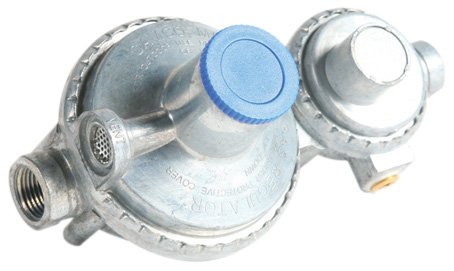
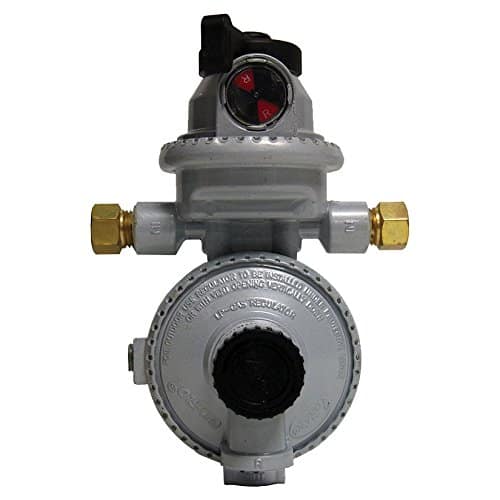
2. Camco 59005 Auto-Changeover Regulator — Best for Dual-Tank Setups
The Camco 59005 is the classic dual-tank auto-changeover regulator that's been an RV industry staple for years. When the primary cylinder empties, the regulator automatically draws from the reserve tank without any interruption to propane flow. This means the furnace keeps running overnight, the fridge stays cold, and there's time to swap out the empty tank at a convenient refill station rather than in a panic. The double-stage design provides smooth, consistent pressure output.
Inlets are 1/4" SAE inverted flare and the outlet is 3/8" NPT female pipe thread — standard RV connections that mate with virtually any existing pigtail and gas line setup. We appreciated that the changeover indicator is clearly visible, making it easy to tell which tank is currently active. The body is weather-resistant, though we'd still recommend the standard protective cover for rigs stored outdoors long-term. Installation is straightforward for anyone who's swapped a regulator before — two pigtails in, one line out.
Pros:
- Seamless auto-changeover eliminates propane interruptions
- Double-stage design for consistent 11" WC delivery
- Standard 1/4" inverted flare and 3/8" NPT connections
Cons:
- Pigtails not included in this SKU
- Changeover indicator can be hard to read in low light
3. AP Products Marshall Excelsior MEGR-230 — Best Budget Single-Stage
Not every setup needs a two-stage regulator. The MEGR-230 is a low-pressure single-stage unit rated at 140,000 BTU with a 0.059" orifice diameter. It's purpose-built for simpler propane systems — think a small travel trailer running a two-burner stove and a basic furnace. At 25 PSI inlet pressure and 9" WC delivery, it provides adequate regulation for low-demand applications without the added complexity or cost of a dual-stage unit.
Marshall Excelsior's build quality shines here too. The green body is sturdy, the connection threads are clean, and the internal diaphragm responded well during our pressure-variation tests. Where the MEGR-230 falls short is in extreme cold or with nearly empty tanks — single-stage regulators inherently struggle more in those conditions compared to their two-stage counterparts. For a small pop-up camper or a seasonal setup that doesn't run heavy BTU loads, this is a smart, cost-effective choice.
Key specs:
- Single-stage regulation
- 140,000 BTU capacity at 25 PSI inlet / 9" WC delivery
- 0.059" orifice diameter
Pros:
- Lowest price point in this roundup
- Simple installation — one inlet, one outlet
- Solid Marshall Excelsior build quality at a budget price
Cons:
- Single-stage design less stable in cold temps or low tank levels
- 140,000 BTU may be insufficient for larger rigs with multiple appliances
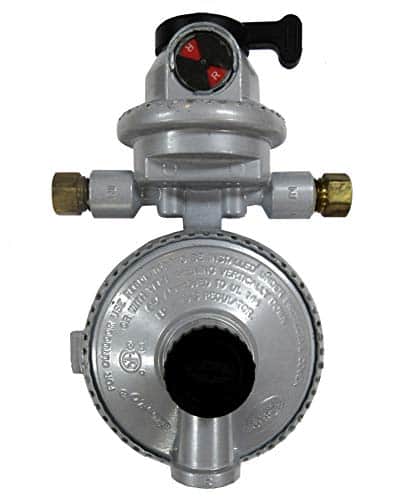
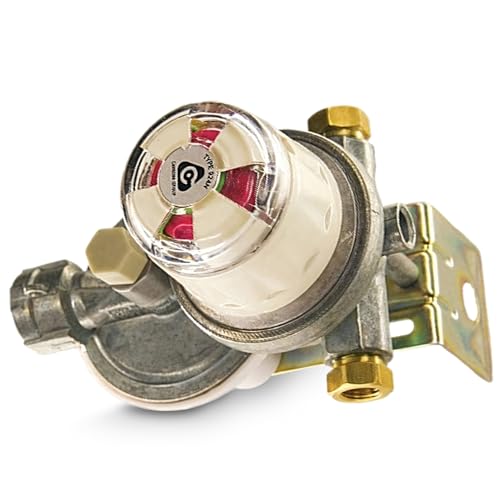
4. Cavagna Kosan 924N — Best Premium Auto-Changeover
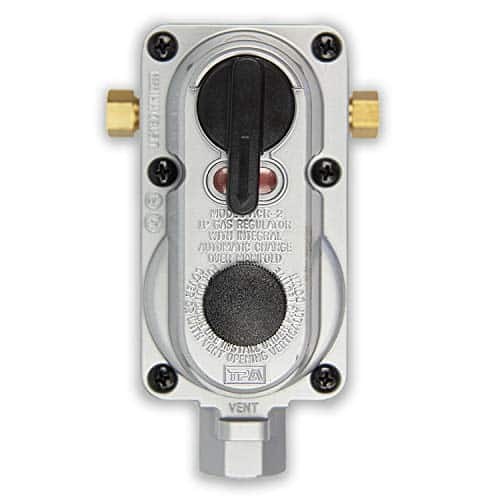
The Cavagna Kosan 924N is the premium pick in this lineup. Cavagna Group is an Italian manufacturer that supplies OEM regulators to several major RV builders, and the 924N reflects that pedigree. This is a full two-stage auto-changeover unit rated at 160,000 BTU with adjustable output pressure and a corrosion-resistant body. The pre-mounted L-bracket simplifies installation significantly — no custom fabrication or adapter plates needed.
What sets the 924N apart is the adjustable pressure feature. Most RV regulators ship locked at 11" WC, but the Cavagna allows fine-tuning for applications that may need slightly different delivery pressure. The top-mounted indicator makes it immediately obvious which tank is active and which is in reserve. During our tests, the changeover was seamless — we ran one tank dry while monitoring a manometer on the outlet, and the pressure dip during switchover was virtually undetectable. The dual propane switching valve design keeps both cylinders ready without any manual intervention.
The 924N delivers steady 11" WC at the default setting, and the two-stage internal architecture handles temperature extremes better than most competitors. For full-timers and four-season RVers, this is the regulator to beat in 2026.
Key specs:
- Two-stage auto-changeover with L-bracket mount
- 160,000 BTU capacity
- Adjustable output pressure
- Corrosion-resistant body
- Top-mounted active tank indicator
Pros:
- Adjustable pressure output — rare at this price point
- Pre-mounted L-bracket eliminates custom fabrication
- OEM-grade build from a major industry supplier
Cons:
- Higher price than competing auto-changeover models
- Slightly bulkier than the Camco 59005
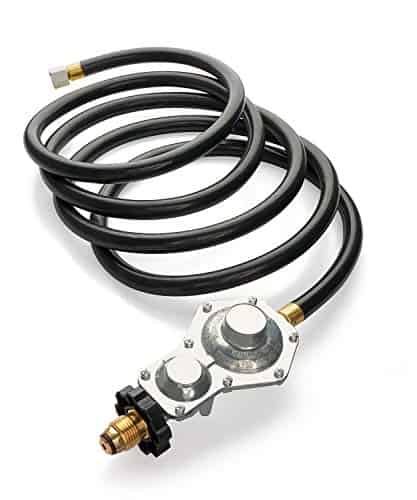
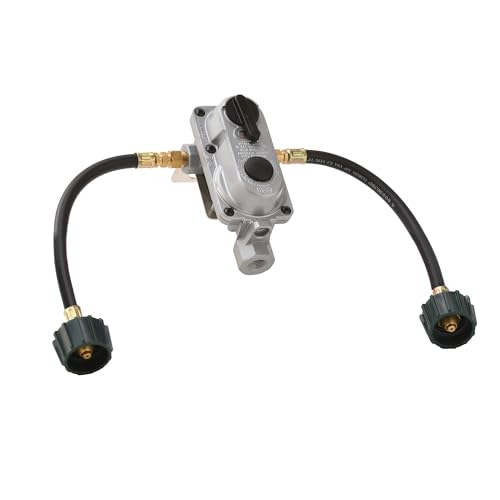
5. Flame King KT12ACR-2 — Best All-In-One Kit
The Flame King KT12ACR-2 is the most convenient option for anyone doing a complete regulator replacement. It ships with two 12-inch pigtails already included, which saves both money and the hassle of sourcing compatible hoses separately. This is a UL-listed two-stage auto-changeover regulator rated at an impressive 345,200 BTU — the highest capacity in our roundup by a significant margin.
That 345,200 BTU rating makes the KT12ACR-2 suitable for large Class A motorhomes and fifth wheels running multiple high-draw appliances simultaneously. The auto-changeover function works as expected: when the primary tank empties, the regulator seamlessly pulls from the reserve. Inlets are 1/4" SAE inverted flare and the outlet is 3/8" NPT female pipe thread — again, standard connections. The included pigtails are 12 inches long, which is adequate for most twin-cylinder compartments but may be tight on rigs with wider tank spacing.
We found the Flame King's diaphragm response to be slightly slower than the Cavagna 924N during rapid demand changes (like firing up a furnace and water heater simultaneously), but the difference is marginal and wouldn't be noticeable in daily use. The value proposition here is hard to beat — regulator plus pigtails in one box, UL listed, and the highest BTU rating available. Anyone also looking to protect their RV's electrical system should check our roundup of the best RV inverters for complementary power management.
Key specs:
- Two-stage auto-changeover
- 345,200 BTU capacity — highest in this roundup
- Includes two 12" pigtails
- UL listed
- 1/4" SAE inverted flare inlet / 3/8" NPT outlet
Pros:
- Includes pigtails — true all-in-one kit
- 345,200 BTU handles the largest rigs
- UL listed for verified safety compliance
Cons:
- 12" pigtails may be short for wide-spaced tank compartments
- Slightly slower diaphragm response than premium competitors
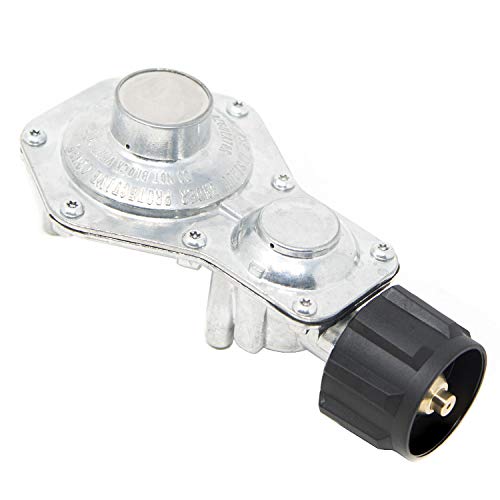
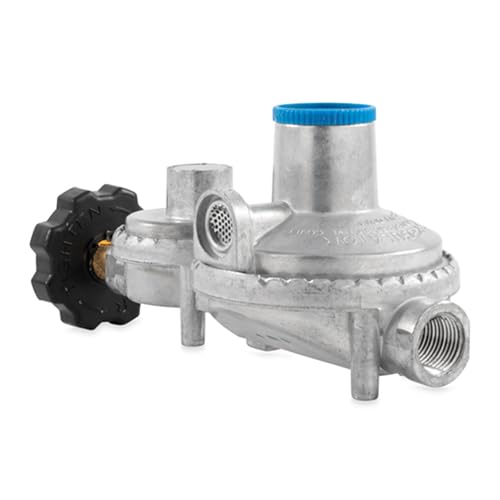
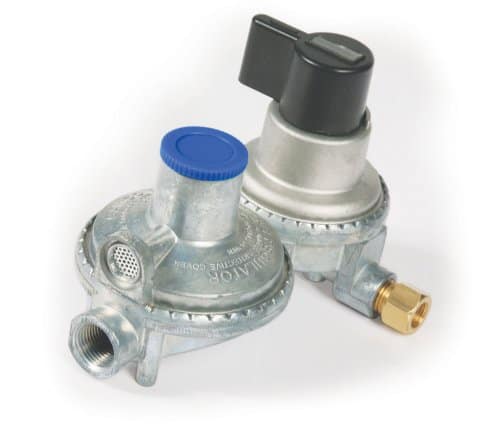
6. Camco 2-Stage Horizontal Mount with POL — Best for Single-Tank Horizontal Mounting
The Camco horizontal-mount POL regulator fills a specific niche: rigs with a single propane tank and a horizontal mounting requirement. Many older travel trailers and some van conversions have compartment layouts that don't accommodate vertical regulators, and this unit addresses that directly. The POL (Prest-O-Lite) inlet connection is the traditional left-hand thread standard found on most North American propane cylinders, making it broadly compatible.
Rated at 160,000 BTU with stable 11" WC output, the Camco horizontal has enough capacity for a mid-size trailer running a furnace, water heater, stove, and fridge simultaneously. The heavy-duty construction minimizes pressure fluctuations — we recorded less than 0.3" WC variance during simulated high-demand cycles. The 3/8" NPT outlet is standard and mates cleanly with copper or CSST gas lines.
One limitation: because this is a single-tank regulator, there's no changeover capability. For weekend warriors with a single 30 lb cylinder, that's not an issue. For extended trips, a dual-tank auto-changeover model would be the better investment.
Pros:
- Horizontal mount solves layout constraints many vertical units can't
- POL connection is universally compatible with standard cylinders
- 160,000 BTU handles most mid-size trailer appliance loads
Cons:
- Single-tank only — no changeover for extended boondocking
- POL connection requires wrench tightening (no hand-tighten QCC1)
7. Flame King G2R150B-POLa Super Compact — Best Space-Saving Design
The Flame King G2R150B-POLa is marketed as "super compact" and it delivers on that claim. This is the smallest two-stage horizontal regulator we tested, making it the obvious pick for van conversions, teardrop trailers, and any build where every cubic inch of compartment space matters. Despite its compact footprint, it uses heavy-duty aluminum and solid brass for the body and connections — no plastic cost-cutting here.
The dual-stage design maintains constant gas pressure under varying demand, and the POL inlet with 3/8"-18 NPT outlet are standard connections. Flame King rates this unit for use with 100 lb ASME tanks and generators in addition to standard RV cylinders, which makes it versatile enough for off-grid power setups too. We noticed the compact body does run slightly warmer than larger regulators during sustained high-draw testing, but temperatures stayed well within safe operating limits.
For anyone building a custom van conversion or squeezing a propane system into a compact trailer, the G2R150B-POLa delivers full two-stage performance in about 60% of the volume of a standard unit. It pairs well with other space-conscious RV upgrades — our guide to the best RV vent fans covers another category where compact sizing matters.
Pros:
- Smallest two-stage horizontal regulator we tested
- Heavy-duty aluminum and solid brass construction
- Compatible with 100 lb ASME tanks and generators
Cons:
- Single-tank POL only — no auto-changeover
- Body runs slightly warm under sustained high-draw conditions

Buying Guide: How to Choose the Best RV Propane Regulator
Single-Stage vs. Two-Stage Regulation
This is the most fundamental decision. A single-stage regulator reduces tank pressure to appliance-level pressure in one step. It's simpler, cheaper, and adequate for low-BTU setups. A two-stage regulator does the job in two steps — first reducing to an intermediate pressure (around 10-15 PSI), then down to the final 11" WC delivery. The result is significantly more stable output pressure, especially in cold weather or when the tank is running low.
Our recommendation for 2026: unless the rig runs only a stovetop or a single small appliance, go with a two-stage regulator. The price difference is minimal compared to the performance improvement. Any RV running a furnace, especially in cold climates, will benefit from the smoother pressure delivery a two-stage unit provides.
Auto-Changeover vs. Single-Tank
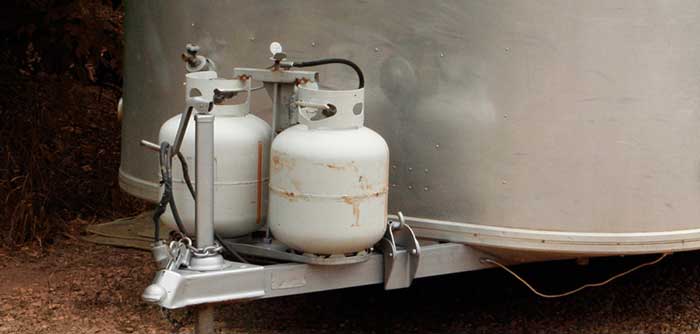
Auto-changeover regulators connect to two propane tanks simultaneously and automatically switch from the empty primary to the full reserve. This is essential for:
- Full-time RVers who can't afford propane interruptions
- Boondockers camping far from refill stations
- Cold-weather campers running furnaces overnight
- Any rig with dual-tank compartments as factory equipment
Single-tank regulators are lighter, simpler, and cheaper. They work well for weekend camping, van conversions with a single cylinder, and setups where propane demand is low and refills are convenient.
BTU Capacity and Appliance Load
Every propane regulator has a maximum BTU rating. To size correctly, add up the BTU ratings of all propane appliances that could run simultaneously:
- RV furnace: 20,000–40,000 BTU
- Water heater: 10,000–16,000 BTU
- Stovetop (3 burners): 15,000–30,000 BTU
- Propane fridge: 1,500–2,000 BTU
- Oven: 8,000–12,000 BTU
A mid-size trailer with all appliances running might draw 60,000–80,000 BTU. A large Class A with dual furnaces could exceed 100,000 BTU. Always choose a regulator rated above the maximum simultaneous draw — a 20-30% margin is standard practice.
Connection Types and Mounting Orientation
RV propane regulators use several connection standards:
- POL (Prest-O-Lite): Traditional left-hand thread inlet. Requires a wrench. Found on older tanks and many bulk cylinders.
- QCC1/Type 1 (ACME): Modern hand-tighten connection with built-in excess flow protection. Standard on new 20 lb and 30 lb cylinders.
- 1/4" SAE Inverted Flare: Common inlet on auto-changeover regulators where pigtails connect the regulator to the tanks.
- 3/8" NPT: Standard outlet connection to the RV's main gas line.
Mounting orientation matters too. Vertical-mount regulators hang below the connection point and are standard on many RVs. Horizontal-mount models extend outward and work better in tight compartments or with ASME tanks mounted lengthwise. Always match the mounting orientation to the compartment layout — installing a vertical regulator horizontally (or vice versa) can affect diaphragm performance and may void the warranty.
Questions Answered
How often should an RV propane regulator be replaced?
Most manufacturers recommend replacing RV propane regulators every 10–15 years, though many RV technicians suggest inspection every 5 years and replacement at 10. Signs of a failing regulator include yellow or flickering burner flames, soot buildup on appliances, a strong gas smell near the regulator, or inconsistent appliance performance. Rubber diaphragms degrade over time from UV exposure and temperature cycling, even when the regulator appears functional externally.
What is the difference between single-stage and two-stage RV propane regulators?
A single-stage regulator reduces high tank pressure (up to 200+ PSI) directly to the 11" WC appliance operating pressure in one step. A two-stage regulator does this in two steps — first reducing to around 10-15 PSI, then to 11" WC. The two-stage approach delivers more consistent output pressure, particularly in cold weather or when the tank drops below 25% capacity. Two-stage regulators cost slightly more but are considered the industry standard for any RV running multiple appliances.
Can a propane regulator be installed in any orientation?
No. Propane regulators are designed for either vertical or horizontal mounting, and installing them in the wrong orientation can cause internal diaphragm issues, vent blockage, or even regulator failure. Always match the regulator's specified mounting orientation to the installation location. The vent opening must face downward in vertical installations to prevent moisture and debris from entering.
What causes a propane regulator to freeze up?
Regulator freeze-up is caused by moisture in the propane supply. As liquid propane vaporizes and expands through the regulator, the temperature drops significantly. If there's water vapor in the gas, it can freeze inside the regulator and block gas flow. This is more common with refilled tanks from stations that don't properly purge moisture. Using dry propane from reputable suppliers and installing a regulator with a larger vent capacity helps prevent this issue.
Do RV propane regulators need a cover?
While not always required by code, a protective cover is strongly recommended for any regulator mounted in an exposed location. Covers shield the vent and diaphragm from rain, snow, insects (especially mud dauber wasps, which are notorious for nesting in regulator vents), and UV degradation. Most aftermarket covers cost under $15 and can extend the regulator's service life by several years.
How can one test if an RV propane regulator is working properly?
The most reliable method is a manometer test: connect a water-column manometer to the regulator's outlet and verify the reading is within 0.5" of the rated WC (typically 11" WC for RV systems). Without a manometer, observe burner flame color and stability across all appliances — consistent blue flames indicate proper regulation, while yellow tips or fluctuating flames suggest the regulator is failing. A soap-and-water bubble test on all connections checks for leaks but doesn't verify pressure accuracy.
Buy on Walmart
- AP Products Marshall Excelsior MEGR-253P Reg 2-Stage Auto Ve — Walmart Link
- Camco Propane Double-Stage Auto-Changeover Regulator | Featu — Walmart Link
- AP Products Marshall Excelsior MEGR-230 Low Pressure Single — Walmart Link
- Cavagna Kosan 924N RV Propane Regulator for RV Trailer, Auto — Walmart Link
- Flame King (KT12ACR-2) 2-Stage Auto Changeover LP Propane Ga — Walmart Link
- Camco RV Propane Regulator 2 Stage Horizontal Mount with POL — Walmart Link
- Flame King 2 Stage Propane LP Horizontal Super Compact Regul — Walmart Link
Buy on eBay
- AP Products Marshall Excelsior MEGR-253P Reg 2-Stage Auto Ve — eBay Link
- Camco Propane Double-Stage Auto-Changeover Regulator | Featu — eBay Link
- AP Products Marshall Excelsior MEGR-230 Low Pressure Single — eBay Link
- Cavagna Kosan 924N RV Propane Regulator for RV Trailer, Auto — eBay Link
- Flame King (KT12ACR-2) 2-Stage Auto Changeover LP Propane Ga — eBay Link
- Camco RV Propane Regulator 2 Stage Horizontal Mount with POL — eBay Link
- Flame King 2 Stage Propane LP Horizontal Super Compact Regul — eBay Link
Key Takeaways
- The Flame King KT12ACR-2 offers the best overall value with included pigtails, auto-changeover, and the highest BTU rating (345,200) in this roundup.
- The Cavagna Kosan 924N is the premium choice for full-timers and four-season campers who need adjustable pressure output and OEM-grade build quality.
- Two-stage regulators outperform single-stage units in nearly every real-world RV scenario — the marginal cost difference pays for itself in pressure consistency and cold-weather reliability.
- Always size the regulator above the total simultaneous BTU draw of all propane appliances, with a 20-30% safety margin.


About Jake Mercer
Jake Mercer spent twelve years behind the wheel as a long-haul trucker, covering routes across the continental United States and logging well over a million miles. That career gave him an unusually thorough education in CB radio equipment — he has tested base station antennas, magnetic mounts, coax cables, and handheld units in real-world conditions where reliable communication actually matters. After leaving trucking, Jake transitioned to full-time RV travel and has since put hundreds of RV accessories through their paces across national parks, boondocking sites, and full-hookup campgrounds from Montana to Florida. At PalmGear, he covers RV gear and accessories, CB radios, shortwave receivers, and handheld radio equipment.
You can get FREE Gifts. Or latest Free phones here.
Disable Ad block to reveal all the info. Once done, hit a button below