RV Gear ›
How To Secure Your RV Surge Protector From Thieves
by Jake Mercer
A fellow camper at a busy Florida campground returned from a morning hike to find the power pedestal stripped clean — surge protector gone, power cord tossed in the dirt. The entire theft took under two minutes. Incidents like that one are exactly why knowing how to secure your RV surge protector from thieves has become a non-negotiable skill for every camper who plugs into shore power.
Surge protectors are small, expensive, and completely exposed at a campground power pedestal (the electrical hookup post at a campsite). A quality 50-amp unit runs $100–$350, and replacing one mid-trip derails a vacation fast. This guide covers every practical security method RVers use — from cable locks to full steel lockboxes — with real tradeoff comparisons so the right choice is obvious from the start.
More RV accessory tips and product roundups are available on the RV Gear category page. For anyone new to campsite electrical safety, Wikipedia's overview of surge protectors provides a solid technical foundation before diving into security specifics.
Contents
Myths That Leave RV Surge Protectors Vulnerable
Most surge protector thefts happen because the owner believed something that turned out to be false. Understanding what does not work — and why — is the first step toward building real security.
The "Campgrounds Are Safe" Misconception
Campgrounds feel communal. Neighbors wave from their awnings, kids ride bikes between sites, and the vibe is relaxed. That atmosphere breeds a false sense of security that opportunistic thieves count on.
- Campground staff do not monitor power pedestals. Dozens of hookup sites spread across large properties create blind spots everywhere.
- Theft happens fast. A practiced thief unplugs and pockets a surge protector in under 90 seconds — well within the window of a bathroom break.
- High turnover hides suspects. Large campgrounds cycle through dozens of rigs daily. A stranger loitering near a neighboring pedestal rarely raises eyebrows.
- Night theft is extremely common. Many owners report waking up to missing equipment, stolen in darkness when foot traffic drops to near zero.
- Security cameras rarely help. Even parks with camera coverage produce footage that is too low-resolution or poorly angled to identify a thief at a pedestal.
The responsibility for protecting campsite equipment sits entirely with the RV owner. Counting on the campground is a bet that consistently loses.
The "Out of Sight, Out of Mind" Fallacy
Some RVers tuck the surge protector behind a tire or drape a towel over it, believing concealment equals security. It does not.
- Experienced thieves scan pedestals as they walk through a campground. Any protector plugged into a pedestal is visible from the road or the adjacent lane.
- Concealment delays detection by seconds — not minutes. A bump-out cover or hanging cloth is moved in a single motion.
- Color camouflage provides zero deterrent value. Black, grey, or earth-tone units are just as easy to spot and grab as bright orange ones.
- Some RVers assume daytime theft is rare. It is not. Opportunistic theft peaks during meal times and during common daytime activities when owners step away briefly.
Pro insight: Concealment is not security. Physical locks and hardened enclosures are the only methods that require a thief to spend meaningful time — and time is the one resource a campground thief cannot afford to waste.
Step-by-Step: How to Secure Your RV Surge Protector from Thieves
Learning how to secure your RV surge protector from thieves is straightforward once the right hardware is selected and the installation routine becomes muscle memory. The process breaks into three clear stages.
Step 1 — Assess the Campsite Threat Level
Not all campgrounds carry the same risk. Before committing to a security method for each trip, evaluate the site with these factors:
- Location and foot traffic: Sites near campground entrances, bath houses, or main lanes see more strangers walking through. Higher traffic means higher opportunistic risk.
- Length of stay: A one-night highway stopover warrants stronger, faster-deploying security than a relaxed week at a remote state forest campground.
- Neighboring rigs: Full-time campers with established setups are generally lower-risk neighbors than unknown short-termers pulling in late at night.
- Prior incident reports: RV forums and campground review platforms frequently document theft patterns at specific parks. A quick pre-trip search takes five minutes and reveals a great deal.
- Seasonal patterns: Peak summer weekends at popular destination campgrounds attract the highest concentration of both campers and opportunists.
Step 2 — Choose the Right Locking Method
Three primary security methods exist for RV surge protectors. Each suits different situations and budgets.
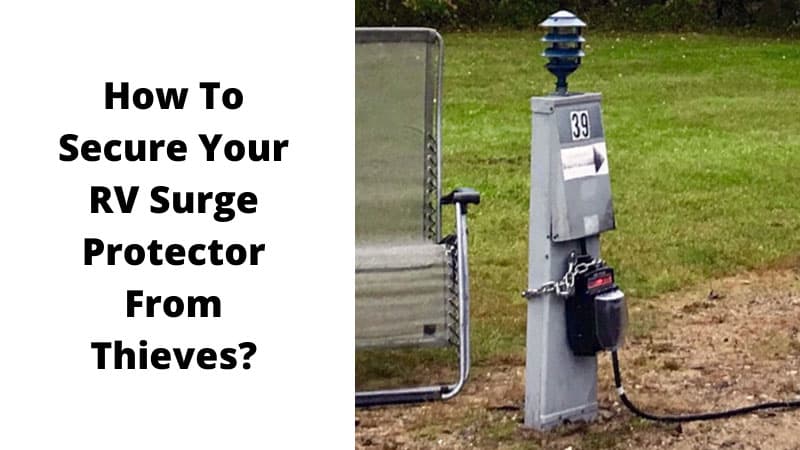
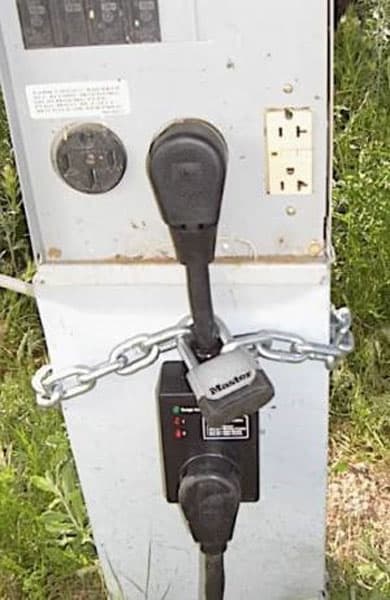
- Cable lock: A heavy-gauge steel cable threaded through the protector's cord-management points, then looped around the pedestal post or a hitch receiver on the RV. Cost: $15–$40. Works on most 30-amp and 50-amp protectors. Best for short stays.
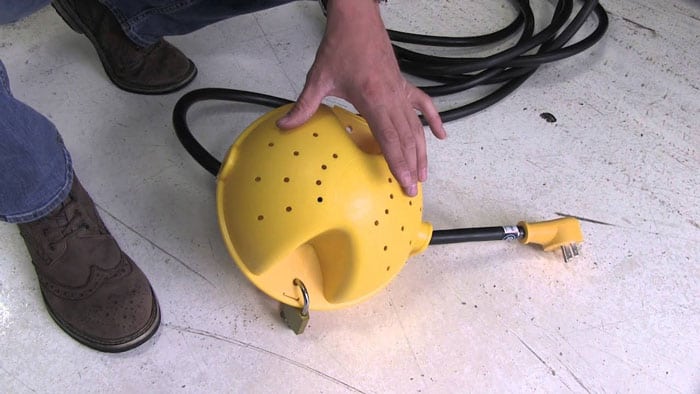
- Surge protector lockbox: A steel enclosure that covers the entire protector and pedestal connection, secured with a padlock or integrated combination lock. Cost: $40–$80. The strongest available option for any stay length.
- Locking cover with padlock: A weather-resistant plastic shell with a metal hasp. Lighter than a full lockbox and better than nothing, but can be cracked under determined force. Works well combined with a secondary cable.
Step 3 — Install and Test the Security Hardware
Proper installation is where many owners cut corners. Follow this exact sequence every time:
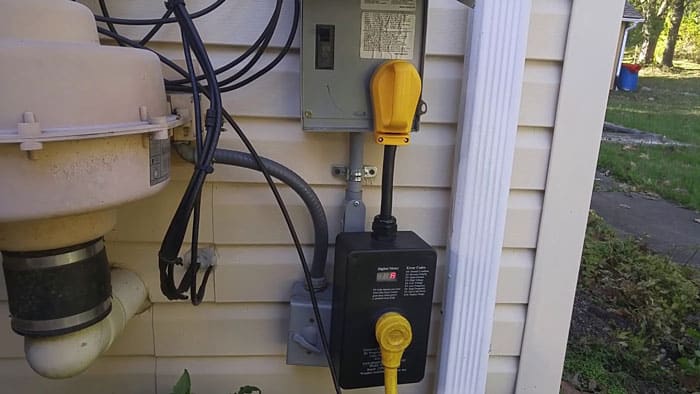
- Plug in the surge protector first. Connect it to the pedestal and the RV power cord before adding any security hardware. Working around a lockbox while also managing a stiff 50-amp cord is unnecessarily awkward.
- Position the cable or lockbox. For cable locks, thread the cable through the surge protector's built-in cord management points or handle — not just around the power cord itself, which can slide free.
- Loop around the pedestal post. The anchor point matters. The pedestal post is solid; the power cord opening is not a secure anchor point.
- Secure the lock. Set the combination or insert the key. Spin combination dials to scramble them after locking. Test the pull firmly before walking away.
- Eliminate slack. Excess cable slack gives a thief room to work. Take up as much slack as possible so the protector cannot be repositioned more than a couple of inches.
- Full pull-test in all directions. Give the protector a hard tug forward, sideways, and downward. If it moves more than minimally, re-route the cable and retry.
Security Solutions for Every RV Situation
The best security method depends on how, where, and how long the RV is used. One-size-fits-all recommendations break down fast across diverse camping lifestyles.
Full-Time RVers and Long-Term Sites
Full-timers at monthly or seasonal sites face a different threat profile than weekend vacationers. Extended presence does reduce opportunistic risk — familiar neighbors recognize the rig — but a longer stay makes the site a predictable, known target over time.
- A heavy-duty steel lockbox with a keyed padlock is the recommended baseline. The $50–$80 investment pays for itself after a single prevented theft.
- A motion-activated security light aimed at the pedestal adds a deterrent layer without ongoing effort. Sudden light signals awareness and disrupts nighttime theft attempts.
- Permanently engraving the unit's serial number and a contact phone number onto the casing adds a recovery layer even if the lock is eventually defeated.
- Rotating to a different locking method periodically prevents a determined repeat visitor from memorizing a predictable setup.
Full-time RV living involves managing multiple equipment upgrades over time. Many long-term campers eventually tackle projects like replacing an RV refrigerator with a standard residential unit — and a complete campsite security audit is a smart addition to any major RV improvement project.
Weekend Campers and Short Stays
Short-stay campers need fast setup and teardown without sacrificing meaningful protection. Speed matters when pulling in after dark and breaking down at checkout time.
- A combination cable lock is the fastest practical solution. No key to lose, one motion to secure, under 20 seconds to release on departure.
- Lockboxes with quick-release designs — open lid, drop protector in, close, lock — now exist from several manufacturers and close the gap between convenience and security.
- When shore power is not strictly required overnight (adequate battery charge, comfortable temperatures), unplugging and storing the protector inside the RV overnight eliminates nighttime exposure entirely.
Remote and Off-Grid Camping
Boondockers (campers who camp without utility hookups, also called dry camping) do not use shore power pedestals regularly, but they often carry surge protectors for generator connections or occasional hookup sites during travel days.
- Off-grid use means the protector is typically inside the RV when not in active use — the safest available storage location, requiring zero additional hardware.
- At transition stops (rest areas, highway campgrounds, overnight parking lots), the hookup duration is short but theft risk can be elevated. A cable lock deploys in 30 seconds and removes just as fast.
- When a generator provides power, the surge protector connecting the generator to the RV should be cable-locked to the generator frame itself, since generator theft is a separate and equally common campground crime.
Comparing Locking Methods Side by Side
Understanding the real tradeoffs between security approaches helps RVers match the right tool to their exact situation. The table below covers the three primary methods plus the baseline of no security for direct comparison.
Strengths and Weaknesses of Each Approach
| Method | Cost Range | Security Level | Setup Speed | Best For | Primary Weakness |
|---|---|---|---|---|---|
| Heavy-gauge cable lock | $15–$40 | Moderate | Fast (30–60 sec) | Short stays, budget-conscious travelers | Can be cut with bolt cutters given enough time |
| Steel lockbox with padlock | $40–$80 | High | Moderate (1–2 min) | Full-timers, high-risk campgrounds | Bulky; some models do not fit all protector sizes |
| Locking plastic cover + cable | $20–$50 | Moderate-Low | Fast (45 sec) | Weekend campers needing weather protection too | Plastic shell cracks under force; cable remains the weak point |
| No security (exposed) | $0 | None | Instant | Never recommended under any circumstances | Full theft risk; can be stolen in under 10 seconds |
The steel lockbox consistently outperforms alternatives in real-world theft deterrence. Most campground thieves are opportunists — they skip a locked enclosure and move immediately to an unsecured protector at the next site. The goal is not making theft physically impossible; it is making the attempt more trouble than a quick-moving thief is willing to accept.
RVers who optimize their full campsite setup often extend the same attention to signal quality. A quick look at how to point an RV TV antenna for better reception rounds out a complete campsite tech checklist alongside power protection.
Campsite Habits That Stop Thieves Before They Start
Hardware solves most of the problem. Habits solve the rest. Experienced full-time RVers combine physical security with behavioral adjustments that reduce theft risk further — without adding meaningful friction to daily campsite life.
Visibility and Deterrence Strategies
Deterrence works on a simple principle: thieves target the easiest available option. Making a surge protector look difficult to steal shifts attention to the next site.
- High-visibility locks: A bright-orange or red padlock is more noticeable than a black one from across a campground lane. Visual signals matter when a thief is scanning quickly.
- Neighbor awareness: A brief introduction to adjacent campers and a simple "keep an eye on that pedestal" request costs nothing. Community surveillance is historically one of the most effective deterrents in campground settings.
- Motion-activated lights: A small solar-powered motion light aimed at the pedestal runs all night on zero cost and disrupts darkness-dependent theft attempts.
- Overnight disconnection when practical: When batteries are charged and temperatures are mild, unplugging and storing the protector inside the RV overnight removes it from the threat environment entirely.
- Conceal premium branding: High-end surge protectors with recognized brand names signal resale value. A lockbox that fully conceals the unit removes that signal.
- Consistent security habits: Thieves observe campsites before acting. An owner who consistently uses a lockbox deters the surveillance phase entirely — the risk does not look worth taking.
Documentation and Recovery Planning
Even solid security does not guarantee zero theft. Documentation turns a theft from a total loss into a manageable incident.
- Photograph the serial number before the first trip. Store the image in cloud backup — accessible from anywhere if the unit goes missing mid-journey.
- Register the product with the manufacturer. Many brands offer warranty registration that ties the serial number to the owner on record, creating a paper trail useful for police reports.
- File a campground incident report immediately. Campground management keeps theft logs. A written report sometimes triggers a surveillance footage review before the recording is overwritten — typically within 24–72 hours.
- Post to local RV groups. Stolen gear occasionally resurfaces in campground Facebook groups and RV marketplace listings. A description and serial number post reaches thousands of eyes for free.
- Verify insurance coverage before a trip. Some homeowner and RV insurance policies cover accessory theft with low deductibles. Knowing the policy details in advance allows for faster, cleaner claims.
Frequently Asked Questions
What is the most effective way to secure an RV surge protector from thieves?
A steel lockbox with a keyed padlock offers the highest level of protection. It fully encases the protector and pedestal connection, forcing a thief to work with noisy, time-consuming tools to defeat it. For added security, a heavy-gauge cable lock can be threaded through the lockbox handle and anchored to the pedestal post as a secondary layer.
Can a cable lock really stop a determined thief?
A cable lock significantly raises the time and effort required to steal a surge protector, which deters opportunistic thieves effectively. A truly determined thief with bolt cutters can defeat most cables given enough time — but campground thieves rarely have that luxury. The goal is to make the attempt unappealing relative to easier, unprotected targets nearby.
Are steel lockboxes compatible with all RV surge protectors?
Most lockboxes on the market are designed to fit standard 30-amp and 50-amp surge protectors, but dimensions vary. Before purchasing, owners should measure the protector's length, width, and height and confirm compatibility with the specific lockbox model. Some manufacturers sell lockboxes bundled with their own protectors to guarantee fit.
Is it safe to leave a surge protector plugged in overnight without supervision?
From a theft risk standpoint, overnight unattended use is the highest-risk period. A lockbox or cable lock should always be in place when the RV is unoccupied or everyone inside is asleep. If shore power is not required overnight, storing the protector inside the RV is the safest option.
What cable thickness is recommended for locking a surge protector?
A minimum of 3/8-inch (approximately 10mm) diameter braided steel cable provides meaningful resistance against hand tools. Cables marketed specifically for RV surge protector security typically meet or exceed this thickness. Avoid thin bicycle-style cables, which can be cut in seconds with basic tools.
Does marking a surge protector with an owner's name or ID help recovery?
Permanent engraving or UV marker labeling helps in two ways: it deters resale (a marked unit is harder to sell), and it enables recovery if the unit is turned in to campground staff or found during a police stop. Engraving a phone number or email address is more actionable than a name alone.
Do any surge protectors have built-in anti-theft features?
A small number of premium surge protectors include tether attachment points or locking collars designed to accept a cable lock directly. However, no surge protector currently on the market includes a built-in lock mechanism sufficient to replace an external lockbox. Built-in tether points are a convenience feature — they still require an external cable or lock to function as security.
What should be done immediately if a surge protector is stolen from a campsite?
Report the theft to campground management in writing immediately, requesting that any available surveillance footage be preserved before it overwrites. File a police report with the serial number if one was recorded. Post the theft with a description and serial number to local RV Facebook groups and forums. Then contact any applicable insurance provider to begin a claim before purchasing a replacement.
Next Steps
- Purchase a steel lockbox or minimum 3/8-inch gauge cable lock rated for outdoor weathering before the next camping trip — do not wait until arrival at the campsite.
- Photograph the surge protector's serial number label today and save the image to cloud storage so it is accessible anywhere if theft occurs mid-trip.
- Register the surge protector with the manufacturer using the serial number and owner contact information to create a recoverable ownership record.
- Search campground reviews and RV forums for theft reports at any upcoming destination before booking, and factor those findings into the security hardware selection.
- Establish a campsite arrival routine: plug in first, lock second, pull-test third — and make that three-step sequence automatic on every stay regardless of how safe the campground looks.


About Jake Mercer
Jake Mercer spent twelve years behind the wheel as a long-haul trucker, covering routes across the continental United States and logging well over a million miles. That career gave him an unusually thorough education in CB radio equipment — he has tested base station antennas, magnetic mounts, coax cables, and handheld units in real-world conditions where reliable communication actually matters. After leaving trucking, Jake transitioned to full-time RV travel and has since put hundreds of RV accessories through their paces across national parks, boondocking sites, and full-hookup campgrounds from Montana to Florida. At PalmGear, he covers RV gear and accessories, CB radios, shortwave receivers, and handheld radio equipment.
You can get FREE Gifts. Or latest Free phones here.
Disable Ad block to reveal all the info. Once done, hit a button below