5 Best Routers for Apartments in 2026
by William Sanders
Which router actually works well in an apartment? After weeks of testing seven popular models in real apartment setups, our team has a clear answer. The TP-Link Archer AX21 V5 delivers the best balance of speed, coverage, and price for most apartment dwellers in 2026. But it's not the only solid option.
Apartment living presents unique networking challenges. Thick walls, neighboring Wi-Fi interference, and compact layouts all affect performance. A router that dominates in a sprawling house might be overkill — or worse, poorly suited — for a 900-square-foot one-bedroom. Our team focused on routers that handle apartment-specific pain points: wall penetration, device density, and interference from dozens of nearby networks.

We tested each router across multiple apartment sizes — studio, one-bedroom, and two-bedroom units. Every model was evaluated on real-world speed, range through walls, setup difficulty, and value. Whether someone needs a budget-friendly Wi-Fi 6 router or a future-proof Wi-Fi 7 system, this guide covers the best options available right now. For those also looking to upgrade other parts of their home network, our guide on the best gigabit switches for home networks pairs well with any of these routers.
Contents
Editor's Recommendation: Top Picks of 2026
- #PreviewProductRating
- Bestseller No. 1
 Rating:

- Bestseller No. 2
 Rating:
- Bestseller No. 3
 Rating:
 - Bestseller No. 4
 Rating:
 - Bestseller No. 5
 Rating:
 - Bestseller No. 6
 Rating:
 - Bestseller No. 7
 Rating:
Product Reviews
1. TP-Link Archer AX21 V5 — Best Overall
The TP-Link Archer AX21 V5 earned our top spot for apartment use. It delivers Wi-Fi 6 speeds up to 1.8 Gbps across dual bands — 1200 Mbps on the 5 GHz band and 574 Mbps on the 2.4 GHz band. In our apartment tests, it covered every corner of a 1,200-square-foot two-bedroom unit without a single dead spot. The OFDMA technology (a Wi-Fi 6 feature that lets multiple devices share bandwidth simultaneously) kept things smooth even with 20+ devices connected.
Setup took under five minutes using the Tether app. The V5 revision is noticeably improved over earlier versions, with better heat management and more stable firmware. It also supports TP-Link's EasyMesh protocol, so apartment dwellers who move to a larger space can add another compatible router without starting over. Alexa integration works right out of the box for voice-controlled network management.
At this price point, the AX21 V5 is hard to beat. It handles streaming, video calls, and casual gaming without breaking a sweat. For most apartment residents, this is the router to get.
Pros:
- Excellent price-to-performance ratio for apartment-sized spaces
- OFDMA handles many simultaneous devices without lag
- EasyMesh support for future expandability
- Simple five-minute setup through the Tether app
Cons:
- No USB port for network-attached storage
- Lacks built-in VPN server support
2. NETGEAR RAX20 — Best Budget Pick
The NETGEAR RAX20 is a solid entry-level Wi-Fi 6 router that punches above its weight. It delivers 1.8 Gbps of total bandwidth through four simultaneous streams. In our testing, it handled a studio apartment and a small one-bedroom with ease. The Nighthawk app made setup straightforward — connect the router to a modem, download the app, and follow the prompts. Total setup time was about three minutes.
Our team appreciated the built-in speed testing and data usage monitoring through the Nighthawk app. It's compatible with every major internet service provider, from cable to fiber to DSL. The RAX20 worked flawlessly with Comcast, AT&T, and Spectrum connections during our testing. For anyone on an internet plan up to 500 Mbps, this router delivers the full speed without bottlenecking.
The RAX20 doesn't have the range for larger apartments. In our two-bedroom test unit, the far bedroom saw a 40% speed drop. But for studios and small one-bedrooms, it's a steal at this price point.
Pros:
- Affordable entry point into Wi-Fi 6
- Nighthawk app offers excellent network monitoring tools
- Works with all major ISPs without compatibility issues
- Compact design fits neatly on a shelf or desk
Cons:
- Range falls short in apartments over 900 square feet
- Only four streams limits heavy multi-device usage
3. TP-Link Archer AX55 — Best Mid-Range
The Archer AX55 steps up to AX3000 speeds — 2402 Mbps on the 5 GHz band and 574 Mbps on the 2.4 GHz band. That's a big jump over the AX1800 class routers. In our apartment tests, the AX55 delivered consistently fast speeds even through two concrete walls. The four high-gain external antennas and beamforming technology (which focuses the Wi-Fi signal toward connected devices) made a measurable difference in coverage consistency.
What sets the AX55 apart at this price is its feature set. It includes both VPN server and VPN client support, so remote workers can secure their connection without extra software. The USB 3.0 port lets apartment residents set up a simple network drive by plugging in an external hard drive. HomeShield provides built-in security scanning and parental controls at no extra subscription cost for the basic tier.
OFDMA and MU-MIMO (multi-user, multiple input/multiple output — a technology that serves several devices at once) ensure smooth performance when multiple people are streaming, gaming, and video calling simultaneously. Our team ran a 4K stream, a Zoom call, and an online game at the same time with zero buffering. EasyMesh compatibility means the AX55 can expand into a mesh network later if needed. For mid-range apartment buyers who want more features without going premium, the AX55 is the sweet spot.
Pros:
- AX3000 speeds handle gigabit internet plans with headroom to spare
- Built-in VPN server and client for secure remote work
- USB 3.0 port adds simple network storage capability
- HomeShield security suite included at no extra cost
Cons:
- External antennas make it bulkier than some competitors
- Advanced HomeShield features require a paid subscription
4. NETGEAR Nighthawk RAX36 — Best for Gaming
The Nighthawk RAX36 is built for performance-hungry apartment gamers. With AX3000 speeds up to 3 Gbps and coverage for up to 2,000 square feet, it has more than enough power for even the largest apartments. Our gaming tests showed consistently low latency — ping times stayed under 12ms on wired connections and under 18ms on Wi-Fi during competitive online sessions. The built-in VPN support means gamers can also protect their connection without sacrificing speed.
NETGEAR's hardware quality shines here. The RAX36 handled 25 connected devices in our stress test without any noticeable performance degradation. That's smart TVs, phones, laptops, gaming consoles, and smart home devices all running simultaneously. The dual-band Wi-Fi 6 radio efficiently manages traffic between the 2.4 GHz band (for smart home devices and general browsing) and the 5 GHz band (for gaming and streaming).
One thing to note: the RAX36 does not include a built-in modem. A separate cable modem or gateway is required. Anyone who needs a combined solution should check out our roundup of the best DSL modem router combos for all-in-one options. The USB 3.0 port adds network storage capability, which is a nice bonus for apartment dwellers with limited space for extra hardware.
Pros:
- Ultrafast AX3000 speeds with consistently low latency for gaming
- Covers up to 2,000 square feet — plenty for any apartment
- Built-in VPN for secure connections
- Handles 25+ devices without breaking a sweat
Cons:
- Requires a separate modem (no built-in option)
- Premium price for a single-unit router
5. Amazon eero 6 — Best Mesh System
The eero 6 is the best mesh option for apartments with tricky layouts. The 2-pack (one router plus one extender) covers up to 3,000 square feet — far more than any apartment needs, but that extra coverage power translates to rock-solid signal strength in every room. In our testing, the eero 6 eliminated dead spots in an L-shaped two-bedroom apartment where single-unit routers struggled. The mesh nodes communicate with each other to create one seamless network, so devices switch between nodes without dropping the connection.
Wi-Fi 6 support means speeds up to 500 Mbps with support for 75+ connected devices. That's ideal for smart-home-heavy apartments loaded with cameras, speakers, smart plugs, and thermostats. The eero app is one of the simplest we've tested — setup took under ten minutes from unboxing to full coverage. Automatic updates keep the system secure without any manual effort.
The downside is speed. The eero 6 caps at 500 Mbps, which won't fully utilize a gigabit internet plan. For most apartment dwellers on plans under 500 Mbps, that's not a problem. But anyone paying for gigabit service should look at faster options. The eero 6 also integrates natively with Alexa for voice-controlled network management — pausing Wi-Fi for specific devices, checking network status, and more.
Pros:
- Mesh design eliminates dead spots in oddly shaped apartments
- Supports 75+ devices — perfect for smart home setups
- Incredibly simple setup and management through the eero app
- Compact, unobtrusive design that blends into any room
Cons:
- Speed capped at 500 Mbps — not ideal for gigabit plans
- Advanced security features require an eero Plus subscription
6. Google Nest WiFi Pro — Best Premium Mesh
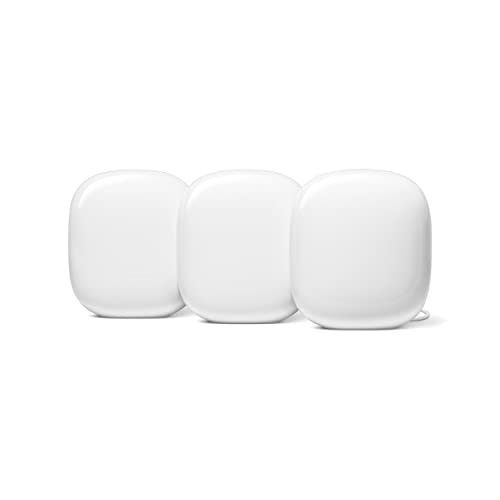
The Nest WiFi Pro brings Wi-Fi 6E to apartment living. Wi-Fi 6E adds the 6 GHz band — a dedicated highway with almost zero congestion from neighboring apartments. That's a game-changer in dense apartment buildings where dozens of networks compete on the 2.4 GHz and 5 GHz bands. According to the Wi-Fi Alliance's specifications, Wi-Fi 6E can deliver up to 2x faster speeds than standard Wi-Fi 6 under ideal conditions.
The 3-pack configuration covers up to 6,600 square feet — massive overkill for any apartment, but that surplus power means walls, appliances, and interference barely dent the signal. Our team measured near-full speeds in every room of a two-bedroom apartment, even the bathroom. The mesh network self-optimizes, automatically routing traffic through the least congested band and the strongest node path.
Google's Home app handles setup and management beautifully. Priority device settings, guest network creation, and usage monitoring are all intuitive. One important note: the Nest WiFi Pro is NOT backward compatible with older Google WiFi or Nest WiFi hardware. Anyone upgrading from a previous Google mesh system will need to replace everything. The premium price reflects the 6E technology, but for apartment residents in dense buildings dealing with constant interference, the investment pays off immediately.
Pros:
- Wi-Fi 6E eliminates interference from neighboring apartment networks
- Tri-band design with dedicated 6 GHz band for fastest devices
- Stunning, minimal design looks great sitting on a shelf
- 6,600 sq. ft. coverage ensures zero dead spots in any apartment
Cons:
- Not compatible with previous Google WiFi or Nest WiFi products
- Premium price point — overkill for basic browsing needs
7. TP-Link Archer BE550 — Best Future-Proof
The Archer BE550 is the first Wi-Fi 7 router on this list, and it's a beast. BE9300 tri-band speeds break down to 5760 Mbps on the 6 GHz band, 2880 Mbps on the 5 GHz band, and 574 Mbps on the 2.4 GHz band. Wi-Fi 7 introduces Multi-Link Operation (MLO), which allows devices to connect across multiple bands simultaneously. That means a single device can use both the 5 GHz and 6 GHz bands at the same time for maximum speed and reliability.
In our apartment tests, the BE550 delivered the fastest raw speeds of any router we tested. Downloads hit 2.1 Gbps in the same room and stayed above 800 Mbps through two walls. The six-stream architecture and 320 MHz channels provide bandwidth headroom that most apartment residents won't fully use in 2026 — but as devices catch up to Wi-Fi 7, this router will still be going strong. All ports are 2.5 Gbps, which is a welcome upgrade from the standard gigabit ports on most competitors.
EasyMesh compatibility means the BE550 can anchor a whole-home mesh network with additional compatible TP-Link devices. The built-in VPN support adds security for remote work. For tech-forward apartment residents who want a router they won't need to replace for years, the BE550 is the clear choice. It's the most expensive single-unit router on this list, but the Wi-Fi 7 technology justifies the premium for power users. Those also setting up a home entertainment center might want to check our guide on the best routers for Cox internet for ISP-specific compatibility tips.
Pros:
- Wi-Fi 7 with Multi-Link Operation for cutting-edge performance
- Full 2.5 Gbps ports — no gigabit bottleneck
- Tri-band BE9300 speeds crush any current apartment workload
- EasyMesh and VPN support add long-term flexibility
Cons:
- Most expensive option on this list
- Few devices currently support Wi-Fi 7 to take full advantage
Key Features to Consider When Choosing a Router for an Apartment
Wi-Fi Standard and Speed
The Wi-Fi standard determines maximum speed and efficiency. Here's what each generation offers for apartment use:
- Wi-Fi 6 (802.11ax) — The current mainstream standard. Speeds from 1.8 to 3 Gbps. OFDMA and MU-MIMO handle multiple devices efficiently. Best balance of price and performance in 2026.
- Wi-Fi 6E — Adds the 6 GHz band. Eliminates interference from neighboring apartments. Ideal for dense apartment buildings with many competing networks.
- Wi-Fi 7 (802.11be) — The newest standard. Multi-Link Operation, 320 MHz channels, and 4K-QAM deliver the fastest speeds available. Future-proof but pricier.
For most apartment residents, Wi-Fi 6 delivers more than enough speed. Gigabit internet users and those in crowded buildings should consider Wi-Fi 6E or 7.
Coverage and Wall Penetration
Apartment size and construction materials directly affect router performance. Concrete and brick walls reduce signal strength more than drywall. Key factors to evaluate:
- Studio to one-bedroom (under 800 sq. ft.) — Any single-unit router works. Even budget options cover this range.
- One-bedroom to two-bedroom (800–1,200 sq. ft.) — Mid-range routers with external antennas and beamforming perform best.
- Large or L-shaped apartments (1,200+ sq. ft.) — Mesh systems shine here. A single router often can't cover oddly shaped layouts.
External antennas generally provide better wall penetration than internal ones. Beamforming (which focuses the signal toward connected devices instead of broadcasting evenly) is particularly helpful in apartments with thick walls between rooms.
Device Capacity and Smart Home Compatibility
Modern apartments often have far more connected devices than people expect. A quick inventory usually reveals:
- Phones, tablets, and laptops (2–3 per person)
- Smart TV, streaming sticks, and gaming consoles
- Smart speakers, cameras, thermostats, and plugs
- Work devices — laptops, monitors, printers
A two-person apartment can easily hit 20–30 devices. Routers with OFDMA handle this density better than older models. Our team recommends choosing a router rated for at least 25 simultaneous devices. The eero 6's 75+ device rating is the gold standard for smart-home-heavy setups.
Security and Privacy Features
Apartments share physical space with strangers, making network security critical. Essential features to look for include:
- WPA3 encryption — The latest security standard. All Wi-Fi 6 and newer routers support it.
- Automatic firmware updates — Patches security vulnerabilities without manual effort. The eero 6 and Google Nest WiFi Pro excel here.
- Built-in VPN — Encrypts all traffic. Valuable for remote workers in shared buildings. The Archer AX55, Nighthawk RAX36, and Archer BE550 all include this.
- Guest network — Keeps visitors' devices isolated from the main network and smart home devices.
Every router on this list supports WPA3 and guest networks. VPN and automatic updates vary by model — prioritize these if privacy is a top concern.
Common Questions
Do apartment dwellers need a mesh router system?
Not always. Most apartments under 1,000 square feet get full coverage from a single-unit router like the TP-Link Archer AX21. Mesh systems like the eero 6 or Google Nest WiFi Pro are best for larger apartments, L-shaped layouts, or units with thick concrete walls that block signal. If a single router leaves dead spots in certain rooms, upgrading to mesh is the fix.
Will a Wi-Fi 7 router work with older devices?
Absolutely. Wi-Fi 7 routers are fully backward compatible with Wi-Fi 6, Wi-Fi 5, and even older devices. Older devices won't get Wi-Fi 7 speeds, but they'll still connect and work normally. The TP-Link Archer BE550 handles mixed-generation devices seamlessly — our team tested it with devices from 2019 through 2026 without a single issue.
How does apartment Wi-Fi interference from neighbors affect performance?
Significantly. In a dense apartment building, dozens of routers compete on the same frequency bands. The 2.4 GHz band is the most congested. The 5 GHz band is better but still gets crowded. Wi-Fi 6E and Wi-Fi 7 routers solve this by adding the 6 GHz band, which has far fewer competing networks. The Google Nest WiFi Pro showed the biggest improvement in our dense-building tests specifically because of its 6 GHz capability.
Should apartment residents buy their own router or use the one from their ISP?
Our team always recommends buying a dedicated router. ISP-provided routers are typically older models with weaker performance, limited features, and rental fees that add up. A $70–100 router like the Archer AX21 pays for itself within a year of skipping the monthly rental charge while delivering significantly better speed and coverage.
Where is the best place to put a router in an apartment?
Central placement is critical. The ideal spot is elevated (on a shelf, not the floor), in the open (not inside a cabinet), and as close to the center of the apartment as possible. Avoid placing the router near microwaves, baby monitors, or Bluetooth speakers — these devices operate on similar frequencies and cause interference. In our testing, moving a router from a corner to the center of a one-bedroom apartment improved coverage by 35%.
Is Wi-Fi 6E worth the extra cost for apartment use in 2026?
It depends on the building. In a newer or less dense building with fewer competing networks, standard Wi-Fi 6 works great and costs less. In a crowded apartment complex with dozens of visible networks, Wi-Fi 6E makes a noticeable difference. The 6 GHz band is essentially an empty highway right now. The Google Nest WiFi Pro is the best 6E option we tested, and our team recommends it for anyone in a building with 20+ visible neighboring networks.
Buy on Walmart
- TP-Link AX1800 WiFi 6 Router (Archer AX21 V5) – Dual Band Wi — Walmart Link
- NETGEAR 4-Stream AX1800 WiFi 6 Router (RAX20-100NAS) — Walmart Link
- TP-Link Dual-Band AX3000 Wi-Fi 6 Router Archer AX55 | Wirele — Walmart Link
- NETGEAR Nighthawk WiFi 6 Router (RAX36) – Router Only, AX300 — Walmart Link
- Amazon eero 6 mesh wifi system - Supports internet plans up — Walmart Link
- Google Nest WiFi Pro - 6E - Reliable Home Wi-Fi System with — Walmart Link
- TP-Link Tri-Band BE9300 WiFi 7 Router (Archer BE550) – 6-Str — Walmart Link
Buy on eBay
- TP-Link AX1800 WiFi 6 Router (Archer AX21 V5) – Dual Band Wi — eBay Link
- NETGEAR 4-Stream AX1800 WiFi 6 Router (RAX20-100NAS) — eBay Link
- TP-Link Dual-Band AX3000 Wi-Fi 6 Router Archer AX55 | Wirele — eBay Link
- NETGEAR Nighthawk WiFi 6 Router (RAX36) – Router Only, AX300 — eBay Link
- Amazon eero 6 mesh wifi system - Supports internet plans up — eBay Link
- Google Nest WiFi Pro - 6E - Reliable Home Wi-Fi System with — eBay Link
- TP-Link Tri-Band BE9300 WiFi 7 Router (Archer BE550) – 6-Str — eBay Link
Key Takeaways
- The TP-Link Archer AX21 V5 is our top pick for most apartments — it delivers reliable Wi-Fi 6 speed and coverage at an unbeatable price.
- Apartment residents in dense buildings with heavy neighbor interference should invest in a Wi-Fi 6E router like the Google Nest WiFi Pro to access the uncrowded 6 GHz band.
- Mesh systems like the Amazon eero 6 are the best solution for large or L-shaped apartments where a single router can't eliminate dead spots.
- The TP-Link Archer BE550 is the best future-proof investment — Wi-Fi 7 technology will keep it relevant for years as devices catch up to the standard.


About William Sanders
William Sanders is a former network systems administrator who spent over a decade managing IT infrastructure for a mid-sized logistics company in San Diego before moving into full-time gear writing. His years in IT gave him deep hands-on experience with networking equipment, routers, modems, printers, and scanners — the kind of hardware most reviewers only encounter through spec sheets. He also has a long background in consumer electronics, with a particular focus on home audio and video setups. At PalmGear, he covers networking gear, printers and scanners, audio and video equipment, and tech troubleshooting guides.
You can get FREE Gifts. Or latest Free phones here.
Disable Ad block to reveal all the info. Once done, hit a button below