RV Gear ›
Can You Legally Live in Your RV in Your Backyard? (And How to Do It)
by Jake Mercer
Over 11 million U.S. households own an RV, yet most never ask the critical question until it's too late: can you live legally in your RV camper in your backyard? The short answer is that it depends entirely on your local zoning code — and most codes say no. That said, real legal pathways exist. Agricultural exemptions, caregiver permits, ADU reclassifications, and temporary use permits all open doors that standard residential zoning slams shut. This guide covers exactly what those pathways look like, how to pursue them, and how to build a utility setup that will actually pass code scrutiny.
Start by browsing the RV gear category for equipment that complements a permanent backyard setup. But before you buy anything: lock down the legal foundation first. Skipping that step is what ends with code officers at your gate and a 30-day removal order in your hand.
Contents
Can You Live Legally in Your RV Camper in Your Backyard? What the Law Actually Says
Zoning Classifications That Control Your Options
Most residential zoning codes classify RVs as recreational vehicles, not habitable dwellings. That classification matters enormously. Your camper legally cannot serve as a permanent or semi-permanent residence on a residentially zoned lot — even if you own the property outright. This is the law in the vast majority of U.S. municipalities. Zoning law in the United States is enforced at the local level, meaning there is no federal override or loophole that applies universally.
The four zoning categories below determine how difficult your path will be:
| Zoning Type | RV Habitation Typically Allowed? | Key Condition | Enforcement Risk |
|---|---|---|---|
| Agricultural (A-1, A-2) | Often yes | Health department permit required | Low if properly permitted |
| Rural Residential (RR) | Sometimes | Setback and sanitation compliance | Medium — varies by county |
| Single-Family Residential (R-1) | Rarely | Variance or special use permit needed | High — complaints are common |
| Multi-Family Residential (R-2/R-3) | Almost never | Not applicable | Very high — HOA often adds another layer |
Pull your parcel's exact zoning classification from your county assessor's website or GIS portal. Then read the ordinance section on RV habitation word-for-word — search for "recreational vehicle," "travel trailer," and "temporary dwelling." Don't rely on what your neighbor did or what someone posted in an online forum. Their parcel may differ from yours by 50 feet and one zoning boundary.
A zoning variance is the official mechanism for getting an exemption from standard rules. Variance applications require demonstrating that your specific situation creates a hardship that the standard zoning rule doesn't adequately address. Approval is not guaranteed. The process typically takes several months, requires a public hearing, and costs several hundred to a few thousand dollars in filing fees depending on your jurisdiction. Know this going in.
The HOA Trap Most People Ignore Until It's Too Late
If your property sits within an HOA jurisdiction, you face a second legal layer on top of local zoning. HOA CC&Rs (Covenants, Conditions, and Restrictions) routinely prohibit RV parking in driveways — let alone full-time backyard habitation. No city permit overrides an HOA violation. These are private contracts, and violating them results in escalating fines, liens on your property, and forced removal. Read your CC&Rs cover-to-cover before you assume you're clear. HOA enforcement is often faster and more aggressive than municipal code enforcement.
The Real Trade-offs of Backyard RV Living
Before you commit to a backyard RV setup, run an honest cost-benefit analysis. The lifestyle has real advantages — but the downsides that most proponents gloss over are exactly the ones that break the arrangement six months in.
What Works in Your Favor
- No mortgage or rent payments on the dwelling itself
- Immediate access to the main house's utilities — laundry, full kitchen, guest bathroom
- Shore power hookup eliminates generator noise and fuel costs entirely
- Lower living costs compared to any urban rental market alternative
- Flexibility — the RV moves when your situation changes
- Lower property tax exposure if the RV isn't reclassified as a permanent structure
The financial math is genuinely compelling. If you can navigate the legal side successfully, living in your own backyard RV eliminates one of the largest line items in most budgets. That's a real and significant advantage.
What Fights Against You
- Black and gray water management — tanks fill fast without a permanent sewer connection
- Thermal performance — RVs are not insulated for year-round extreme climate habitation
- Privacy — neighbors have direct sightlines in most suburban backyards
- Property resale — a lived-in backyard RV raises red flags for buyers and appraisers
- Enforcement risk — a single neighbor complaint triggers a code violation visit
Sanitation is the operational dealbreaker for most people. Without a permanent sewer connection, you're pump-hauling waste on a schedule — and that gets expensive and exhausting fast. Thermal management is the second dealbreaker. An uninsulated Class C in a climate with sub-freezing winters or extreme summer heat becomes genuinely uninhabitable without major HVAC infrastructure investment. Address both before you commit.
How to Make It Legal: The Step-by-Step Process
The Permit and Variance Path
Most guides tell you to "check local ordinances" and stop there. That's not enough. Here's the actual process that produces results.
Step one: Pull your parcel's exact zoning classification from the county GIS portal. Step two: Read the zoning ordinance section on RV and temporary dwelling habitation word-for-word. Step three: Contact your local building and planning department directly and ask specifically about:
- Temporary use permits for RV occupation
- ADU (Accessory Dwelling Unit) reclassification for a permanent setup
- Agricultural exemptions if your parcel carries any ag zoning designation
- Caregiver exemptions — many states authorize backyard RVs when the occupant cares for a dependent family member
Pro tip: Before filing any permit application, submit a written pre-application inquiry to your planning department. This creates a documented paper trail and gets you an official written response — far more useful than a verbal answer if code enforcement shows up later.
The caregiver exemption is the most underutilized legal pathway in the country. California, Oregon, Washington, and several other states have specific statutes authorizing a backyard RV or ADU when the occupant provides care to an elderly or disabled family member. It's legitimate, it moves faster than a full variance, and it's specifically designed for this situation. Check your state statutes before pursuing any other route.
ADU reclassification is the strongest pathway for a genuinely permanent arrangement. Under an ADU designation, your RV is treated as a secondary dwelling unit on the parcel — the same legal status as a converted garage apartment. This requires the RV to meet minimum habitability standards, which vary by state but typically include minimum square footage, ventilation, egress, and sanitation requirements. It's a higher bar, but it's the most defensible legal position long-term.
Utility Hookups You'll Need
A legal, livable backyard RV setup requires four core utility connections:
- Shore power: Dedicated 30A or 50A circuit from your main electrical panel — not a standard outdoor outlet
- Potable water: Direct hookup to your house supply line with a calibrated pressure regulator
- Sewer: Gravity-drain tie-in to your home's sewer lateral, or a permitted pump-out arrangement
- GFCI protection: Required on all exterior outlets under NEC code
A pressure regulator is non-negotiable at the water connection. Municipal water pressure regularly hits 80–100 PSI — well above the 40–60 PSI that most RV plumbing systems are rated for. Blow out a fitting under pressure and you're dealing with a flood inside your rig. Our roundup of the best RV water pressure regulators covers the specs you need for a permanent backyard installation.
For sewer, the cleanest permanent solution is a gravity-drain tie-in to your home's main sewer lateral. This requires a licensed plumber and a permit in most jurisdictions — but it's the setup that survives code scrutiny. Our guide to the best RV sewer hose options covers the flexible connection hardware between your RV's termination point and the permanent drain tie-in.
When Your Setup Hits a Wall: Troubleshooting Common Problems
Electrical and Water Issues
If you're tripping breakers constantly, your shore power circuit is undersized. A Class A or Class C motorhome running air conditioning, microwave, and refrigerator simultaneously draws 30–50 amps. A standard 15A or 20A outdoor outlet cannot sustain that load. Hire a licensed electrician to run a dedicated 50A circuit with a proper RV pedestal — this is the permanent solution, not a workaround.
Low water pressure at the RV despite good house pressure points to one of three things: a clogged inlet screen filter, a failed or incorrectly set pressure regulator, or a kinked supply hose. Check them in that order. All three are five-minute fixes once you identify the culprit.
If you're seeing intermittent power loss, check the shore power cord connection at the pedestal first. Vibration from the RV loosens connections over time. A pigtail adapter that's partially seated drops voltage under load and destroys sensitive electronics fast. Gray water discharge is another compliance landmine — dumping gray water onto the ground, even in your own backyard, is classified as improper sewage disposal and is illegal in virtually every jurisdiction. Contain it or plumb it properly.
Handling Neighbor and Code Enforcement Complaints
Neighbor complaints are the leading enforcement trigger for unpermitted backyard RV setups. You don't win these by arguing rights. You win by either getting proper permits — which eliminates the violation — or maintaining proactive neighbor relations before a complaint is ever filed.
If you receive a code violation notice:
- Respond in writing within the stated deadline — missing it escalates the case automatically
- Request a compliance timeline extension immediately — most jurisdictions grant additional time on a first notice
- Document every communication with the code enforcement office in writing
- Consult a local land use attorney if the violation involves potential fines above a few hundred dollars
In most jurisdictions, a first-time violation results in a notice to comply, not an immediate fine. Use that window. Either get properly permitted or formulate a relocation plan. Ignoring code notices escalates to liens and administrative hearings — neither outcome is recoverable cheaply.
The upside of the full-time backyard RV lifestyle is that community and downtime become central to the experience. If you're setting up for the long haul, our guide on game options people can play while traveling in an RV translates equally well to stationary life — keeping the household entertained without relying on outside infrastructure.
When Backyard RV Living Makes Sense — and When It Doesn't
Situations Where It's the Right Move
Backyard RV living is the right call in specific circumstances. Don't let blanket negativity about zoning complexity discourage you if your situation genuinely fits one of these profiles:
- Caregiver arrangements: An aging parent or disabled family member who needs proximity but also independence
- Home renovation or reconstruction: You need to stay on-site during major structural work — practical and short-term
- Agricultural or rural residential property: Your zoning already permits it with minimal paperwork
- Extended family in rural areas: Multiple generations sharing land, not a single structure
- Cost reduction with equity building: You're paying down the property while eliminating the largest line item in your budget
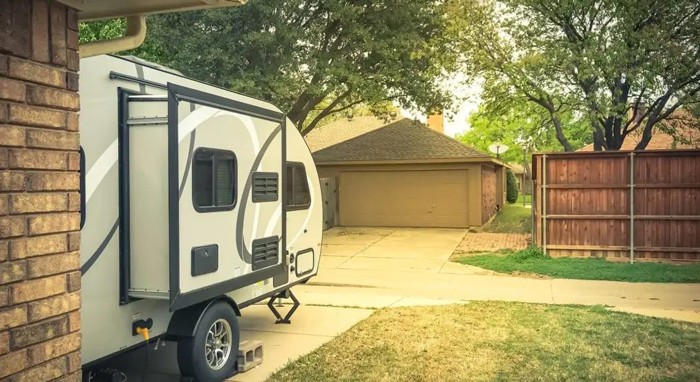
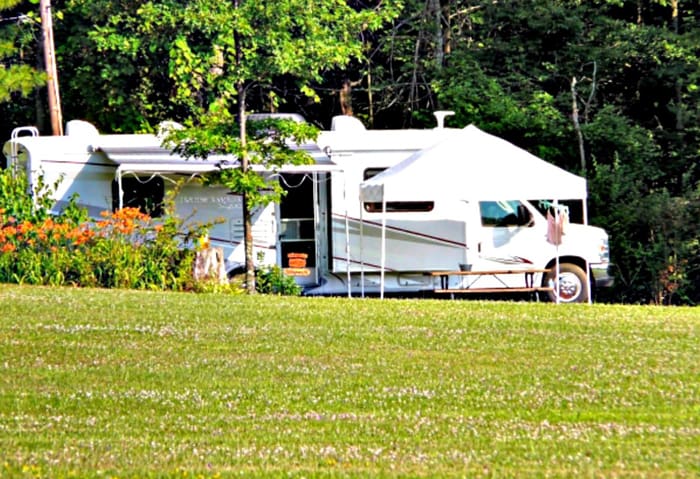
Open land like this — adequate setbacks, no shared fence lines, room for a proper utility run — is the physical environment where backyard RV living actually works. Agricultural zoning is your most permissive legal environment. If your property resembles this setup, your legal path is significantly shorter than most people assume.
When to Look for Other Options
Don't pursue backyard RV habitation in these situations. The risk-to-reward ratio is wrong, and the path to compliance doesn't exist without radical property changes:
- Dense suburban R-1 zones with active HOAs and shared fence lines under 10 feet
- Urban lots where neighbors have direct sightlines to your RV's position from multiple angles
- Any property where you haven't read both the zoning ordinance and the CC&Rs in full
- Situations where the RV is your only housing option and permits have been denied — you're one complaint away from forced displacement with no legal standing
Whether you can live legally in your RV camper in your backyard has a definitive answer only after you've researched your specific jurisdiction. Generic guidance — including this article — cannot substitute for reading your county's actual ordinance code. Do that first. Then make your decision from real information, not assumptions.
Frequently Asked Questions
Is it legal to live full-time in an RV in your backyard?
It depends on your local zoning code. Most R-1 single-family residential zones prohibit full-time RV habitation. Agricultural, rural residential, and some unincorporated areas permit it with a health department or temporary use permit. Always check your specific county ordinance and HOA CC&Rs — there is no universal answer that applies across jurisdictions.
What permits do I need to live in my RV in my backyard?
Permit requirements vary by jurisdiction. Common permits include a temporary use permit, an ADU designation, a health department sanitation permit, and an electrical permit for a dedicated shore power circuit. Many states also have specific caregiver exemptions that streamline the process when the RV occupant is caring for an elderly or disabled family member — check your state statutes first.
How do I connect utilities to a backyard RV for permanent living?
You need four connections: a dedicated 50A shore power circuit from your main electrical panel, a potable water line with a pressure regulator set to 40–60 PSI, a sewer drain tie-in to your home's lateral or a compliant pump-out arrangement, and GFCI protection on all exterior outlets. Each connection typically requires a licensed contractor and a separate permit.
Key Takeaways
- Whether you can live legally in your RV camper in your backyard depends entirely on your local zoning classification and HOA CC&Rs — research both before spending anything on a permanent setup.
- Agricultural and rural residential zoning offers the most permissive legal environment; dense suburban R-1 zones with active HOAs are the hardest to navigate and rarely worth attempting.
- Caregiver exemptions are the most underutilized legal pathway — check your state statutes for this route before pursuing a full zoning variance.
- A properly permitted backyard RV requires a dedicated 50A shore power circuit, a calibrated water pressure regulator, and a sewer lateral drain tie-in — none of these can be skipped for long-term livable habitation.


About Jake Mercer
Jake Mercer spent twelve years behind the wheel as a long-haul trucker, covering routes across the continental United States and logging well over a million miles. That career gave him an unusually thorough education in CB radio equipment — he has tested base station antennas, magnetic mounts, coax cables, and handheld units in real-world conditions where reliable communication actually matters. After leaving trucking, Jake transitioned to full-time RV travel and has since put hundreds of RV accessories through their paces across national parks, boondocking sites, and full-hookup campgrounds from Montana to Florida. At PalmGear, he covers RV gear and accessories, CB radios, shortwave receivers, and handheld radio equipment.
You can get FREE Gifts. Or latest Free phones here.
Disable Ad block to reveal all the info. Once done, hit a button below